Marketing
How to Write a Cold Email and Follow-up That Actually Gets a Reply (With Templates)
Nikhil Adiga · · 10 min read
On this page
- A reader makes three decisions in under 20 seconds
- What is the reply formula?
- Research before you write: account, person, trigger, sender, proof
- Getting opened: a peer sender and a subject line about him
- Getting read: a reason only he has, right now, and something he didn't know
- Getting a reply: one question he can answer from memory, and something for him
- Follow-ups should add something new
- Worked example: one email, colour-coded line by line
- The pre-send checklist
- What does a good reply rate look like?
- How do you do this for hundreds of accounts?
- FAQ
Here's how to write a cold email that gets a reply: research the account, the person and a recent trigger before you write a word. Send it from someone the reader sees as a peer, with a subject line about him. Then give him one reason to care that only applies to him right now, and end with one question he can answer from memory.
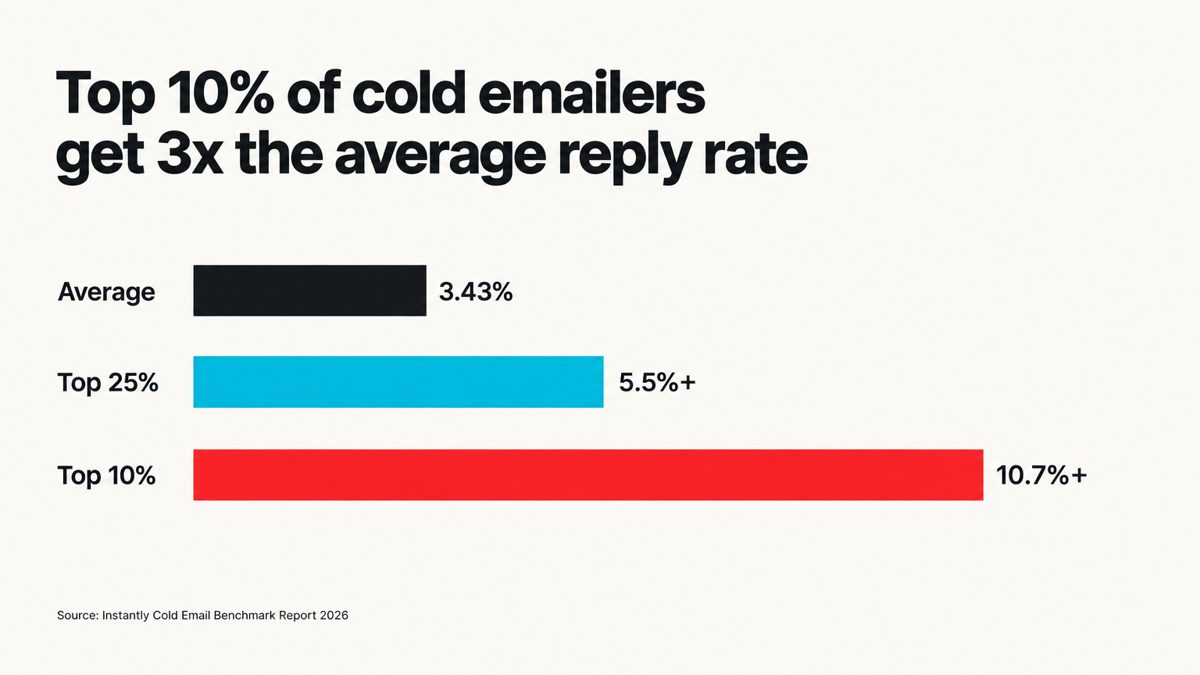
That's the whole method. The rest of this post breaks it into the three decisions every reader makes, shows the research behind each line, takes one email apart line by line, and gives you templates and a pre-send checklist. For scale: Instantly's Cold Email Benchmark Report 2026, based on 2025 sending data, puts the average reply rate at 3.43%, and the top 10% of senders at 10.7% or more. The gap between those two numbers is mostly writing and research, not volume.
A reader makes three decisions in under 20 seconds
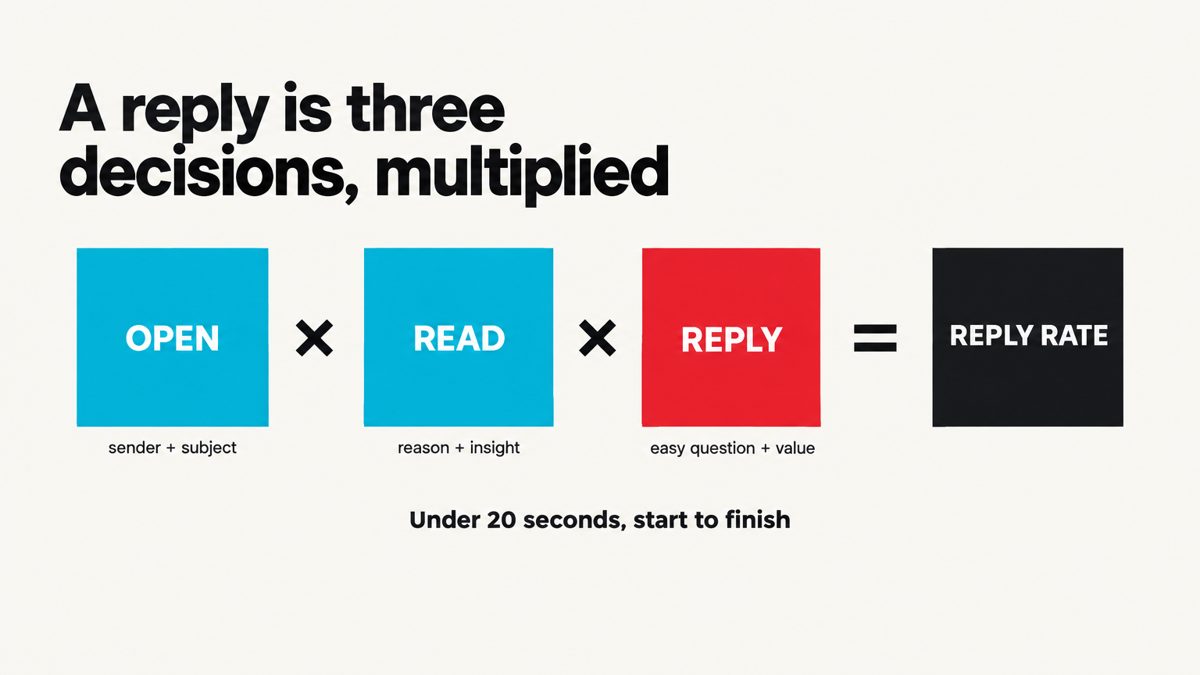
Every cold email gets judged three times, fast: do I open it, do I read it, do I reply? Each decision is a filter, and each one only looks at certain parts of the email.
- Open looks at the sender name, the subject line and the preview text. Nothing else exists yet.
- Read looks at the first line or two. If they don't say why this is for him, he archives it.
- Reply looks at the ask. If answering takes work, he puts it off, and putting it off means never.
Most bad cold emails fail because the writer polishes the part that matters least, usually the pitch paragraph, and ignores the parts that decide the outcome: who it's from, the subject, the first line and the question.
What is the reply formula?
Reply rate is open rate times read rate times answer rate. Because they multiply, a weak link wrecks the whole thing: a brilliant body can't save an email nobody opens, and a great subject line just gets more people to see a bad ask.
| Variable | What the reader is asking | What drives it | What kills it |
|---|---|---|---|
| Open | "Is this from someone like me, about me?" | A peer sender, a subject line that names his world | Brand-first sender names, clickbait, "Quick question" |
| Read | "Why me, why now?" | A trigger only he has, an insight he didn't know | "Hope you're well," a paragraph about your company |
| Reply | "Can I answer this in ten seconds?" | One easy question, something useful for him | "Do you have 30 minutes next week?", three asks at once |
Research before you write: account, person, trigger, sender, proof
Do five minutes of research per email, in this order, and write the answers down before you draft. Every line of a good cold email traces back to one of these five notes.
- The account. What does the company sell, to whom, and at what stage is it? A seed-stage team with one founder selling and a Series B team with an SDR floor have different problems.
- The person. What does he own, what is he measured on, and what has he said publicly? A post, a podcast, a talk or a job description he wrote tells you how he thinks.
- The trigger. What changed recently? New funding, a job posting, a launch, a new market, a leadership hire. The trigger is your "why now."
- The sender. Who on your side does he see as a peer? Founders answer founders. Heads of growth answer people who've run growth.
- The proof. What one specific, checkable thing makes your claim believable to someone like him? One number or one named situation beats a list of features.
If you can't fill in the trigger, don't send yet. A cold email without a "why now" is a newsletter nobody asked for.
Getting opened: a peer sender and a subject line about him
He opens an email when the sender looks like a peer and the subject line is about his world, not yours. Those two things are all he sees.
The sender. Send from a named person with a real title, not a brand or a generic sales inbox. Match seniority where you can: founder to founder, operator to operator. Practitioners on sales forums say the same thing over and over: emails from an obvious "sales rep" get filtered by eye before they're opened.
The subject line. Write two to five words about him, his company or his trigger. Lowercase reads like a colleague; title case reads like marketing.
| Weak subject line | Why it fails | Stronger version |
|---|---|---|
| Quick question | Every seller uses it; says nothing | your two sdr posts |
| Boost your pipeline by 300% | About you, reads as hype | pipeline after the series a |
| {Company} x {YourCompany} | Presumes a partnership he never asked for | {company}'s move into EMEA |
| Following up | No new information | the onboarding teardown |
Your preview text, the first words of the email, is part of the subject line. Make it the trigger, not "Hi {first_name}, I hope this finds you well."
Getting read: a reason only he has, right now, and something he didn't know
He keeps reading when the first line could only have been written to him, this week. That's the trigger from your research, stated plainly.
Then give him something he didn't know. Not a feature: an observation about his situation. "Teams that hire their first two SDRs at the same time usually spend the first quarter on ramp, not pipeline" is a useful sentence even if he never buys. It shows you understand his problem better than the last ten people who emailed him.
Keep the body to three or four short lines. If a line doesn't serve the trigger, the insight or the ask, cut it. The most common cut: the paragraph about your company. He can click your signature if he wants to know.
Getting a reply: one question he can answer from memory, and something for him
He replies when the question takes ten seconds and he already knows the answer. "Do you have 30 minutes on Tuesday?" makes him check a calendar and commit. "Is ramp time or lead volume the bigger problem right now?" he can answer without looking anything up.
Ask exactly one question. Two questions get zero answers.
Then give him something for him, whatever he decides: a short teardown, a benchmark, a list of the three things you'd change. "Happy to send the one-page breakdown either way" turns a sales email into a favour, and favours get answered.
Follow-ups should add something new
A follow-up earns a reply only if it adds something the first email didn't have: new evidence, a different angle, or an easy way to say no. "Just bumping this" adds nothing and reads like a bot.
The short version: send three follow-ups after the opener, reply in the same thread, wait at least three days before the first one, and give each email one new job. Evidence, then a new angle, then close the loop. We wrote the full sequence, with timing and templates, in how to write a cold email follow-up sequence.
Worked example: one email, colour-coded line by line
Here's one email to a fictional head of growth, "Dana," at a fictional Series A SaaS company, "Northwind." Each line is coloured by the research note it came from. If a line has no colour, it shouldn't be there.
Trigger Person Account Proof Ask / value
From: Sam, founder (sender: founder to growth lead, a peer) Subject: your two sdr roles Dana, saw Northwind posted two SDR roles last week , and your podcast point about "pipeline you can forecast" stuck with me. At Series A with a single-product motion, the first two SDRs usually spend their first quarter ramping, so that quarter's pipeline still lands on you. Is ramp time or lead volume the bigger worry this quarter? Happy to send the one-page plan we'd use either way. Sam
Five sentences, under 80 words. The subject and first line are the trigger, the second sentence proves he did his homework on her, the middle line is an insight about her stage, and the close is one easy question plus something for her.
Template 1: Trigger + insight (default)
Subject: {trigger, 2–5 words, lowercase} {First name}, saw {company} {specific trigger}. {One line showing you know his view or role.} At {stage/segment}, {insight about what usually happens next}. Is {problem A} or {problem B} the bigger one right now? Happy to send {resource} either way.
Template 2: The specific-ask email (for busy, high-profile people)
This one follows the format a well-known author and podcaster recommends for reaching people who get hundreds of emails: say who you are in one line, make one specific request, and make it answerable in a sentence.
Subject: one question about {his topic} {First name}, I'm {name}, {one credible line about you}. I know you're busy, so one question: {Specific question he can answer in one or two sentences}? No need to reply beyond that. Thanks either way.
Template 3: The give-first email
Subject: {company}'s {page/process} {First name}, I went through {company}'s {signup flow / pricing page / outbound sequence} and wrote up three things I'd change. {One of them, stated in a sentence.} Want the other two?
The pre-send checklist
Run every email through these eleven checks before it goes. Copy the list into your doc or CRM template and use it as your download.
- ☐ The sender is a named person the reader would see as a peer.
- ☐ The subject line is 2–5 words and about him, his company or his trigger.
- ☐ The preview text (first line) states the trigger, not a greeting.
- ☐ The trigger happened recently and is specific to this account.
- ☐ One line shows you know this person, not just his title.
- ☐ There's one insight he might not already know.
- ☐ No paragraph about your company.
- ☐ Exactly one question, answerable from memory.
- ☐ Something useful is offered, whatever he answers.
- ☐ Under about 100 words, readable on a phone without scrolling.
- ☐ The email address is verified and the follow-ups are written and scheduled.
What does a good reply rate look like?
A good cold email reply rate is anything above about 5.5%, and great is 10.7% or more. Instantly's Cold Email Benchmark Report 2026, built on 2025 sending data, found an average reply rate of 3.43%; the top 25% of senders reached 5.5% or more, and the top 10% reached 10.7% or more. That report counts replies to follow-ups too, so compare it with your whole-sequence rate, not your first-email rate.
Benchmarks disagree because they measure different things. Hunter's State of Email Outreach 2026, based on 31 million emails sent in 2025, reported a 4.5% average sequence reply rate. Belkins' 2025 data, which counts unique replies per email sent, put it at 0.45%. Before you compare yourself to any number, check what it divides by.
| Source (year) | Reply rate | What it counts |
|---|---|---|
| Instantly Cold Email Benchmark Report (2026) | 3.43% average; 5.5%+ top 25%; 10.7%+ top 10% | All replies, including to follow-ups, per email sent |
| Hunter, State of Email Outreach (2026) | 4.5% average | Replies per sequence |
| Belkins (2025 data) | 0.45% | Unique replies per email sent |
Also track positive replies separately. A 6% reply rate that's mostly "remove me" is worse than a 3% rate that's mostly "tell me more." For more detail, see our cold email reply rate benchmarks.
How do you do this for hundreds of accounts?
The writing isn't the bottleneck; the research is. Finding a real trigger and a line about the person for every account is what takes a founder's afternoon. Template the structure, and spend your time on the five research notes.
If you'd rather not do that research by hand, 10ex's autonomous agents find accounts with live buying signals, verify contacts across several data sources, write trigger-based emails and follow-ups, and run them through to a booked meeting. See how it works.
FAQ
How do I write a good cold email?
Research the account, the person and a recent trigger first. Send it from a peer, use a short subject line about him, open with the trigger, add one insight, and end with one question he can answer from memory. Keep it under about 100 words.
What is the 30/30/50 rule for cold emails?
Versions of it vary, and we couldn't find a single authoritative source for it. It's usually described as a rough split of effort across the subject line, the opening and the ask. The useful idea behind it is right: those three parts decide the reply far more than the pitch paragraph does.
What is a good cold email response rate?
Above about 5.5% is good and 10.7% or more is top-tier, according to Instantly's Cold Email Benchmark Report 2026, which found a 3.43% average across 2025 sending data.
How long should a cold email be?
Short enough to read on a phone without scrolling: three to five sentences, roughly 50–100 words. Every line should trace back to the trigger, the person, the insight or the ask.
Is cold emailing illegal?
Cold B2B email is legal in many places but regulated. In the US, CAN-SPAM requires accurate sender details, a non-misleading subject line, a physical address and a working opt-out. Rules in the EU and UK are stricter. Check the rules for the countries you send to, and talk to counsel if you're unsure.
How many follow-ups should I send?
Three after the opener is a sensible default, each adding something new. The full sequence is in our follow-up guide.