Digital Marketing
Cold Email Reply Rate in 2026: What Is a Good Benchmark?
Nikhil Adiga · · 6 min read
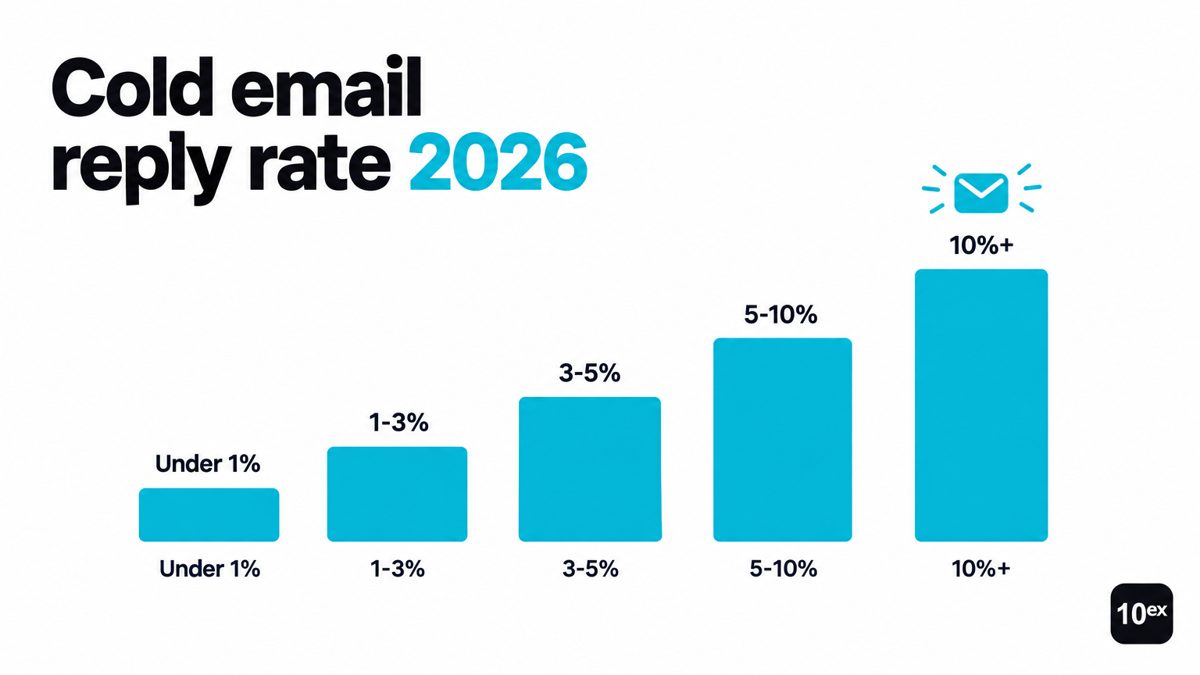
A good cold email reply rate in 2026 is roughly 3 to 5 percent of contacts for a targeted B2B sequence. Strong campaigns clear 5.5 percent, and the top 10 percent of senders pass 10 percent. If you sit below 1 percent, the problem is almost always the list or deliverability, not the copy.
That answer hides a messy truth: published benchmarks for cold email reply rate range from under 0.5 percent to over 10 percent. The gap is not noise. It comes from different denominators, different list sizes and different levels of effort. This roundup pulls the 2026 numbers together, shows why they disagree, and tells you which one to hold your team to.
The finding: list size and denominator explain most of the spread
The biggest single driver of reply rate in 2026 data is how many people get the same campaign. Woodpecker, citing Belkins' 2026 analysis of 16.5 million emails, reports that campaigns under 50 recipients average a 5.8 percent reply rate versus 2.1 percent for large lists. Hunter's 2026 benchmark summary, as reported by Blazehive (2026), shows the same pattern: 6.2 percent for campaigns sent to 21 to 50 recipients, against 2.4 percent for campaigns of 500 or more.
The second driver is the math. Some studies divide replies by every email sent, including follow-ups. Others divide by unique contacts. Danish Lead Co's 2026 benchmark across 344 client campaigns shows how much this matters: 1.21 percent against sends, but 2.70 percent against unique prospects. Same campaigns, more than double the number.
What is a good reply rate for cold emails?
A good reply rate for cold emails is 3 to 5 percent per contact, measured across a full sequence. Here are the sourced 2026 numbers behind that range.
- 3.43 percent average. Instantly's 2026 Benchmark Report puts the platform-wide average reply rate at 3.43 percent, as cited by Mailshake (2026).
- 5.5 percent for strong campaigns, 10.7 percent for the top 10 percent. Same Instantly 2026 data, as summarized by Outreachbloom (2026) and Be Leaded (2026).
- 4.5 percent sequence average. Hunter's analysis of 31 million emails, reported by Spiich Labs (2026), counts replies across the whole sequence.
- 0.74 percent strict median. Smartlead data covering more than 850 million emails in the first half of 2026, cited by Roimaxi (2026), measures replies per email sent at massive volume.
- A falling floor for high-volume senders. Belkins' 2026 study found the first half of 2025 averaged a 0.50 percent reply rate, dropping to 0.40 percent in the second half, a 20 percent decline within one year.
- 17 percent never land. Martal (2026) reports that 17 percent of cold emails never reach any inbox, which caps every other number on this list.
- Practitioner view. A 2026 benchmark thread on Reddit's r/Warmysender calls 5 to 8 percent good and 8 to 10 percent very good, usually on smaller lists. Forum operators skew toward small, hand-built campaigns, so treat that as a ceiling for focused work, not a floor.
Cold email reply rate benchmark table for 2026
Tier | Reply rate (per contact, full sequence) | What it usually means
Broken | Under 1% | Deliverability problem, wrong list, or blast volume
Baseline | 1% to 3% | Decent list, generic message
Good | 3% to 5.5% | Targeted segment, clear offer, follow-ups running
Strong | 5.5% to 10% | Small segments, real personalization, a timely trigger
Top performer | 10%+ | Signal-based lists of under 50 accounts with a sharp reason to reply
Tier ranges are built from the Instantly, Hunter, Belkins and Smartlead 2026 figures above. Use them only after you fix your denominator.
Is cold email still effective in 2026?
Yes, cold email is still effective in 2026, but only for teams that treat it as targeting work instead of volume work. The average for mass senders keeps sliding, as the Belkins 2026 data shows. Meanwhile small, well-researched campaigns still beat 5 percent in the Hunter and Belkins numbers. The channel is not dying. Lazy versions of it are.
For a seed to Series B SaaS company, that is good news. You do not have the volume to win a blasting contest anyway. You do have the ability to pick 40 accounts a week that just raised, just hired, or just posted about a problem you solve.
Which levers actually move cold email reply rate?
Four levers show up repeatedly in the 2026 data: follow-ups, personalization depth, segment size and length.
Follow-ups add about 40 percent of replies
Instantly's 2026 data, reported by Blazehive (2026), found that 42 percent of replies came from follow-up emails. Emailchaser (2026) reports a three-email sequence moving cumulative reply rate from 0.81 percent after email one to 1.61 percent by email three. What to do: run one opener plus two or three follow-ups, and give each one a new reason to reply.
Two real details beat five tokens
Hunter data cited by Blazehive (2026) shows reply rates rising from 3.6 percent with no personalization to 5.6 percent with two personalized attributes. The same source notes gains flatten or fall at five or more attributes. What to do: reference two verifiable facts, such as a recent hire and a funding round, not a stack of merge fields.
Small segments win
The 5.8 percent versus 2.1 percent gap from Belkins' 2026 study is the clearest signal in the dataset. What to do: split prospects into batches of 20 to 50 near-identical accounts and test a message before scaling it.
Short first emails
Be Leaded (2026), summarizing Instantly's benchmark, lists under 80 words as a trait of the best-performing campaigns. What to do: one observation, one problem, one low-friction question.
How should you calculate your own reply rate?
Calculate reply rate as unique contacts who replied divided by unique contacts who received at least one delivered email, across the full sequence. Exclude auto-replies and out-of-office messages. Track positive replies separately, because a 6 percent reply rate full of "unsubscribe" is worse than 3 percent full of "send times."
Fill-in template for your weekly report:
- Contacts delivered: ____
- Unique human replies: ____ (reply rate: ____ %)
- Positive replies: ____ (positive rate: ____ %)
- Meetings booked: ____
- Bounce rate: ____ % (fix anything above 2 to 3 percent before touching copy)
- Largest segment size this week: ____
What should a founder do with these benchmarks?
Set 3 percent per contact as your floor and 5.5 percent as your target, then fix problems in this order: deliverability, list, segment size, message. Most teams start by rewriting copy, which is the lever with the least room to move when the list is wrong.
The hard part is doing the research for small segments every week without hiring SDRs to do it. That is the job 10ex agents take on: they find accounts showing buying signals, verify contact data across multiple sources to keep bounces down, and run the sequence through to a booked meeting. If you want to see how small, signal-based campaigns run on autopilot, try 10ex.
FAQ
What is a good reply rate for cold emails?
A good reply rate for cold emails is 3 to 5 percent of contacts across a full sequence. Instantly's 2026 data puts the average at 3.43 percent and strong campaigns at 5.5 percent or more.
Is cold email still effective in 2026?
Yes. High-volume averages are falling, per Belkins' 2026 study, but campaigns under 50 recipients still average 5.8 percent replies in the same data.
Why do cold email reply rate benchmarks disagree so much?
They use different denominators and samples. Danish Lead Co's 2026 data shows 1.21 percent per send but 2.70 percent per unique prospect for the same campaigns.
How many follow-ups should a cold email sequence have?
Two or three after the opener. Instantly's 2026 data attributes 42 percent of replies to follow-ups.
Does personalization still raise reply rates?
Yes, up to a point. Hunter data shows a lift from 3.6 to 5.6 percent with two personalized attributes, with diminishing returns at five or more.
What reply rate means something is broken?
Anything under 1 percent per contact usually points to deliverability or list quality. Martal (2026) reports 17 percent of cold emails never reach an inbox, so check placement first.