Marketing
Why Google-Era Marketing No Longer Works (and How to Get Meetings Booked in the Age of AI)
Nikhil Adiga · · 6 min read
Google-era marketing no longer works because the click it depended on is going away. Buyers now get their answers in AI summaries and chatbots, and they build a vendor shortlist before they fill in your form. If you want meetings booked in the age of AI, two things matter: get named inside the answers buyers read, and reach the right accounts directly, with a reason to talk, while they are still deciding.
For fifteen years the B2B playbook went like this: rank for a keyword, win the click, gate a PDF, nurture the lead, hand it to an SDR. Each step assumed the buyer would come to your website to learn. Below is what broke, the numbers behind it, and a working system to replace it.
What was Google-era marketing?
Google-era marketing was a traffic machine. Rankings brought clicks, clicks filled forms, and forms became the pipeline. The unit of success was a session on your site. Content was written for crawlers, gated so it could capture emails, and measured in MQLs.
That machine had one dependency it never questioned: the buyer clicking through. Take the click away and every step after it starves.
Why doesn't it work anymore?
Four changes broke it, and each one has data behind it.
1. Most searches no longer end in a click
SparkToro and Datos found that 58.5% of U.S. Google searches in 2024 ended without a click (59.7% in Europe). More than half of the demand you rank for never reaches your site.
2. AI answers take what clicks are left
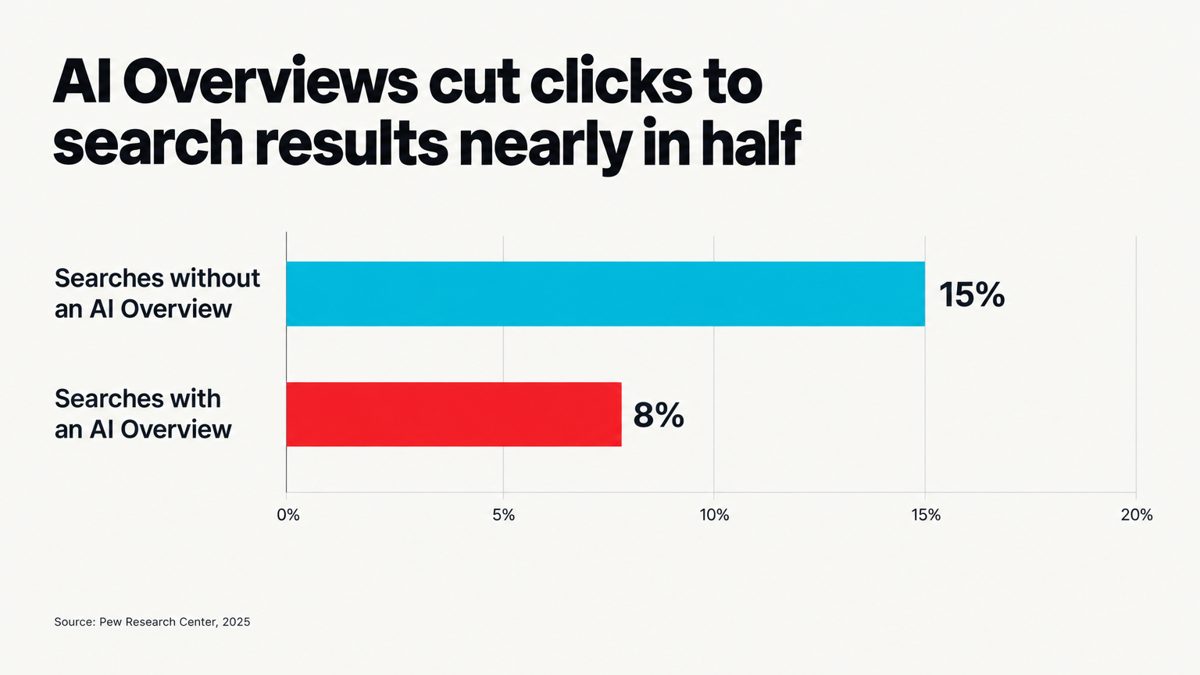
A 2025 Pew Research Center study found that when a Google AI Overview appeared, users clicked a traditional result on 8% of visits, against 15% without one. Only 1% clicked a link inside the overview itself. Ranking first under an AI summary is worth roughly half what it used to be.
3. Buyers start in chatbots, not search boxes
G2's 2026 research reports that 51% of B2B software buyers begin their purchase process in an AI chatbot rather than a search engine, and 63% use ChatGPT for research. The first "page one" your buyer sees is now a paragraph of text, and that paragraph either names you or doesn't.
4. The shortlist is set before sales gets a turn
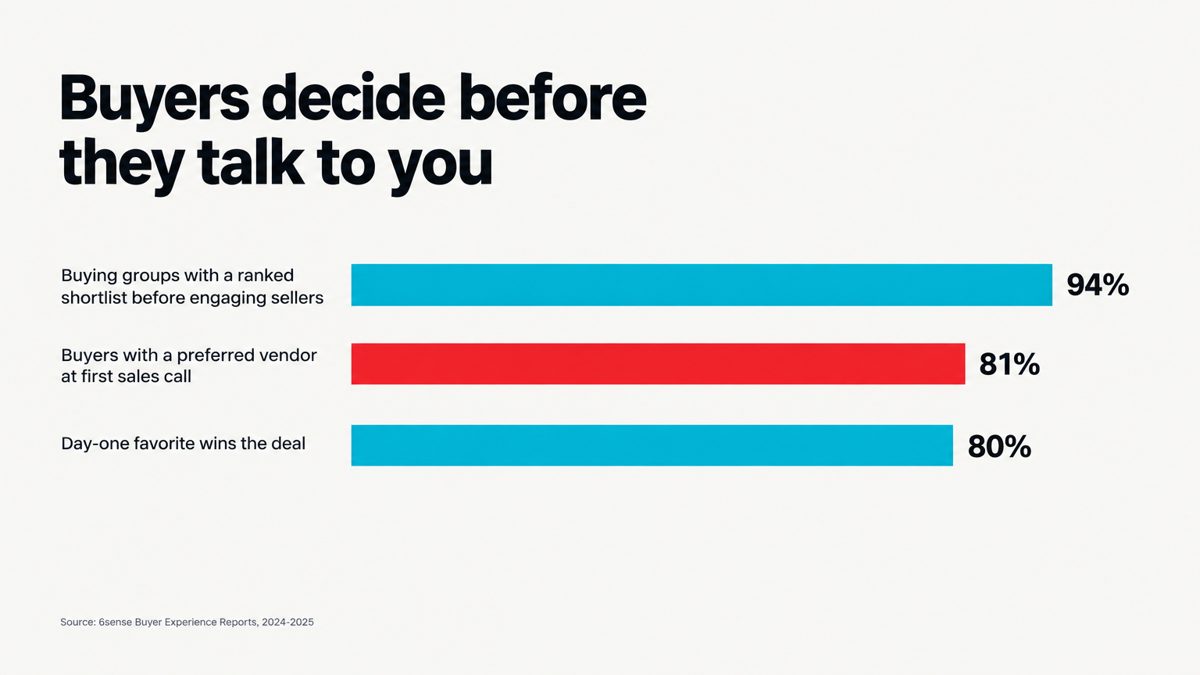
6sense's 2025 Buyer Experience Report found that 94% of buying groups rank their vendor shortlist before they engage sellers, and the vendor preferred on day one wins about 80% of deals. Its 2024 report found 81% of buyers already had a preferred vendor at their first sales conversation. Gartner adds that 61% of B2B buyers prefer a rep-free buying experience (survey of 632 buyers, 2024 fieldwork).
Put those together and the problem is clear. Inbound waits for a buyer to show up, and by the time they do, the decision is mostly made.
Is SEO dead, then?
No. SEO isn't dead, but traffic as the goal is. The pages that AI systems quote are still well-structured, crawlable and specific, so the craft carries over. What changes is the scoreboard: you count citations and booked meetings, not sessions.
The upside is real, too. Octane11's State of B2B AI Search report (Q3 2026) found AI search is only 2.4% of B2B search traffic, yet accounts that find a company through AI close at 2.5x the rate of organic search. That traffic is smaller, and it buys.
Google era vs. AI era: what changes
| Google-era marketing | AI-era meeting engine | |
|---|---|---|
| Goal | Rank and win the click | Be named in the answer, then start the conversation |
| Content | Keyword pages, gated PDFs | Answer-first pages, original numbers, comparisons |
| Who moves first | The buyer (fills a form) | You (act on a signal) |
| Timing | Whenever they show up | While the shortlist is still forming |
| Metric | Sessions, MQLs | AI citations, signal-to-meeting rate, meetings booked |
| Capacity limit | SDR headcount | How many signals you can act on per day |
How do you get meetings booked in the age of AI?
Run a system with five parts: get cited, watch for signals, act within hours, open with a specific reason, and measure meetings. Here is each step.
Step 1: Get cited where buyers ask
Write pages that answer one buyer question in their first two sentences: pricing, alternatives, "how to," "is X worth it." Use plain-question headings, tables, and numbers you own. Then show up where models pull their answers from: forum threads, review sites, LinkedIn posts and comparison pages. Every week, ask the main chatbots your top ten buyer questions and record whether you're named. That list is your new rank tracker.
Step 2: Replace the form with a signal feed
Stop waiting for a form fill and track what buyers do before one. Useful signals: a new hire for an SDR or growth role, a funding round, a competitor's customer complaining in public, a Reddit thread asking for a recommendation in your category, repeat visits to your pricing page. Each one tells you an account is building a shortlist right now.
Step 3: Act within hours, not quarters
The shortlist forms early, so speed beats polish. Set a rule that every high-intent signal gets a relevant touch the same day, whether that's an email, a LinkedIn note or a helpful reply in the thread. If your team can't keep that pace, the signal feed is just a list of missed meetings.
Step 4: Open with the reason, not the pitch
Buyers who prefer rep-free buying still take meetings when there's a clear reason. Use this template:
[Signal you saw] — "Saw you're hiring two SDRs for the mid-market push." [What usually happens next] — "Most teams at that stage spend the first quarter just building lists." [One concrete offer] — "I can show you 50 accounts that match your ICP and are showing intent this week." [Small ask] — "Worth 15 minutes on Thursday?
Keep it under 90 words, use one link at most, and ask one question.
Step 5: Measure meetings, not traffic
Swap your dashboard. Track three numbers each week: how often you're cited for your top buyer questions, how many signals you acted on the same day, and meetings booked per 100 signals. If citations go up and meetings stay flat, your outreach is the problem. If meetings per signal are high but volume is low, widen the signal feed.
What does this mean for a lean team?
The constraint moves from traffic to throughput. A five-person team can't watch every forum, every hiring post and every funding round and still reply the same day. That's why the teams pulling ahead run this loop with autonomous agents: one agent tracks signals, one enriches and checks the contact, one writes and sends the first touch, and one books the slot. People set the ICP and the offer, and the agents do the repetitive work every day.
If you want to see the full loop run on your own market, 10ex runs these agents end to end, from finding buyers to booking the meeting on your calendar.
FAQ
Is SEO dead with AI search?
No. Structured, specific pages are still what AI systems quote. What's fading is SEO measured by traffic. Measure citations and pipeline instead.
Is SEO dead or evolving in 2026?
It's evolving. The skills still apply: clear structure, real expertise, crawlable pages. The target is now the answer engine's summary, not just the ten blue links.
Why don't inbound forms produce meetings like they used to?
Because buyers research in AI tools and rarely click through. 6sense's 2025 report found 94% of buying groups set their shortlist before engaging sellers, so a form fill often arrives after the decision.
What is the fastest way to book more B2B meetings now?
Act on buying signals the same day with a short, specific message tied to the signal, and make sure you're named when buyers ask chatbots about your category.
How do I know if AI tools are recommending my company?
Write down your ten most important buyer questions, ask the main chatbots each week, and log whether you're mentioned and which sources they cite. Then improve or add to those sources.