Marketing
Marketing Competitive Advantage in 2027: The S–D Tier List of What's Commoditized and What Isn't
Nikhil Adiga · · 8 min read

On this page
- What does "commoditized" mean in marketing now?
- The tier list: 17 marketing advantages ranked S to D
- D tier: five things everyone already has
- C tier: copy, contact data and content volume stopped being edges
- B tier: judgment and speed still win, for now
- A tier: relationships, owned distribution and budget compound
- S tier: founder POV, brand trust and first-party data
- How to audit your own marketing budget against the tiers
- The real moat is the whole right column, at once
- FAQ
The short answer Your marketing competitive advantage in 2027 is not copy, contact data, design or content volume. AI has made those cheap and the same for everyone. The edge that's left is what a competitor can't buy for $500 a month: founder point of view, brand trust, first-party data, warm relationships, owned distribution, and the speed to act on all of them at once.
Most B2B marketers are defending the wrong hill. They're pouring budget into things that are already free for everyone, then wondering why the pipeline looks like everyone else's.
So we ran one test on 17 common marketing advantages: can a competitor buy this for $500 a month? If yes, it's table stakes. If no, it's a moat. Then we ranked them S to D.
- 81% of B2B marketers use generative AI in content production (Content Marketing Institute, 2025)
- 95% of winning vendors were on the buyer's Day-One shortlist (6sense Buyer Experience Report, 2025)
- 82% of buyers say thought leadership grows more valuable as AI spreads (Edelman–LinkedIn, 2026)
What does "commoditized" mean in marketing now?
A marketing advantage is commoditized when any competitor can match it with a subscription and an afternoon. The Content Marketing Institute's 2025 research found 81% of B2B marketers already use generative AI in content production, and Litmus data reported by Stripo in 2026 puts the share of email copy written with generative AI at 49%. When most of your market writes with the same tools, good copy stops separating you from anyone.
That's the trap. Commoditized doesn't mean useless. You still need clean copy, a working sequence and a dashboard. It means you can't win on them. They're the price of entry, so spend to be adequate and stop there.
The tier list: 17 marketing advantages ranked S to D
Here's the full ranking. The higher the tier, the longer it takes to build and the harder it is to copy.
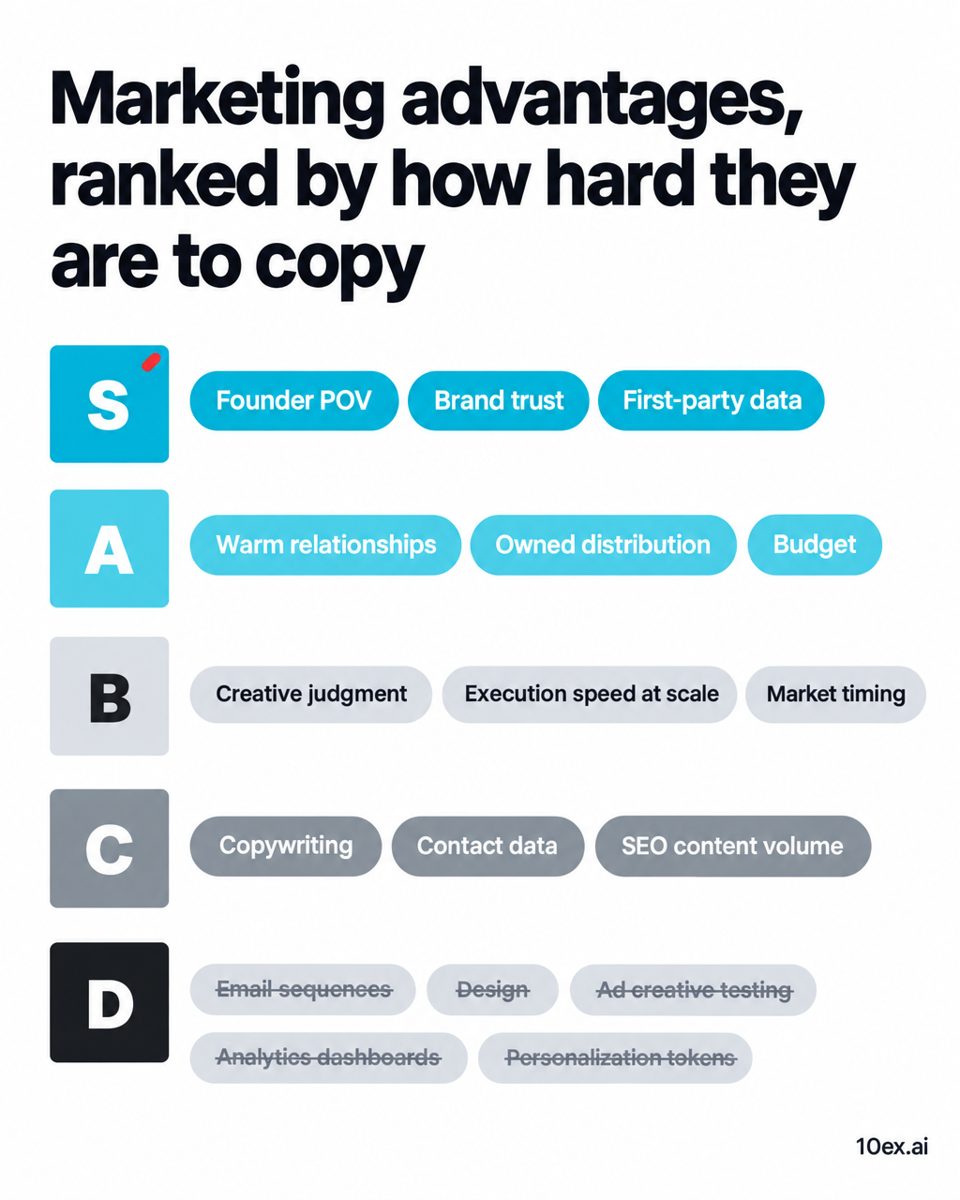
S and A tiers compound. D tier is crossed out because everyone has it.
- S — What it means: Singular to you, compounds forever; Items: Founder POV, brand trust, first-party data; What to do: Invest every week
- A — What it means: Real moat, takes years; Items: Warm relationships, owned distribution, budget; What to do: Build on purpose
- B — What it means: Edge today, window closing; Items: Creative judgment, execution speed at scale, market timing; What to do: Exploit now
- C — What it means: Was an edge three years ago; Items: Copywriting, contact data, SEO content volume; What to do: Automate to "good enough"
- D — What it means: Fully commoditized; Items: Email sequences, design, ad creative testing, analytics dashboards, personalization tokens; What to do: Buy cheap, never compete on it
D tier: five things everyone already has
Every item in D tier ships inside tools most teams already pay for. Drip builders come with every CRM. Design templates and image generation cost a few dollars a month. Ad platforms now generate and rotate creative variations automatically. Free dashboards cover most reporting needs. And {{first_name}} was never a strategy.
Practitioner test: if your agency's main pitch is a D-tier item, you're paying a premium for a commodity. Move that budget up the list.
C tier: copy, contact data and content volume stopped being edges
C-tier items were real advantages around 2022 and are now open to anyone. Contact databases sell the same records to every buyer, so your list overlaps your competitor's list. Anyone can publish dozens of articles a week. And with 81% of B2B marketers using generative AI for content (Content Marketing Institute, 2025), "we write well" isn't a moat.
What to do: automate C tier to a solid B+ and spend the time you save on the tiers above. Verify contact data across more than one source so you aren't paying for bounces, but don't expect the list itself to win deals.
B tier: judgment and speed still win, for now
B-tier items are real advantages today, but the window is closing. Creative judgment means knowing which angle to take and what to cut. Market timing means moving while a trend is still early. Execution speed at scale is the newest: running 400 sequences while a competitor is still writing the brief.
Speed sits in B, not A, because tools are spreading fast. The teams that win here pair speed with S-tier inputs. Fast generic outreach is just faster noise.
A tier: relationships, owned distribution and budget compound
A-tier advantages take years to build and can't be bought overnight. Warm relationships and owned distribution (your email list, community and audience) mean you don't rent attention every quarter. Budget belongs here too, despite the hype about doing more with less: more spend still buys more reach and more tests, and the learning compounds.
The data on trusted voices is strong. Edelman and LinkedIn's 2026 B2B Thought Leadership Impact Report found 81% of B2B decision-makers say amplification by a trusted outside voice substantially increases a company's credibility. The same report found 89% of decision-makers who share thought leadership do it through private channels like email, DMs and meetings, compared with 67% who share publicly. Your best distribution happens in places you can't see, and only relationships get you in.
- 81% say a trusted outside voice substantially raises credibility (Edelman–LinkedIn, 2026)
- 89% vs 67% share thought leadership privately vs. publicly (Edelman–LinkedIn, 2026)
S tier: founder POV, brand trust and first-party data
S-tier advantages belong to you alone and compound the longer you hold them. They decide whether you're on the shortlist before a buyer ever talks to sales, and the shortlist is where deals are won. The 6sense Buyer Experience Report (2025) found 95% of winning vendors were already on the buyer's Day-One shortlist.
- Founder POV. Lived experience and a clear opinion can't be generated. Edelman and LinkedIn (2026) found 59% of final decision-makers say weak or absent thought leadership helped get a vendor removed from consideration.
- Brand trust. It's earned over years and can't be faked at scale. The same report found 78% of decision-makers say strong thought leadership changed their view of a company from vendor to potential strategic partner.
- First-party data. Your buyers' behavior on your site, in your product and in your inbox is data no competitor can buy. Every C-tier contact list is shared; this one isn't.
AI makes S tier more valuable, not less. Edelman and LinkedIn (2026) found 84% of decision-makers used AI to summarize thought leadership while evaluating vendors. Summaries of generic content all look the same. A distinct point of view survives the summary.
How to audit your own marketing budget against the tiers
Take last quarter's marketing spend and time, then sort every line into a tier. Use this fill-in template:
- S — Spend + hours last quarter: $____ / ___ h; % of total: ___%; Target: Growing every quarter
- A — Spend + hours last quarter: $____ / ___ h; % of total: ___%; Target: Growing
- B — Spend + hours last quarter: $____ / ___ h; % of total: ___%; Target: Hold, automate the execution
- C — Spend + hours last quarter: $____ / ___ h; % of total: ___%; Target: Shrinking
- D — Spend + hours last quarter: $____ / ___ h; % of total: ___%; Target: Minimum viable
We left the targets as directions, not percentages, because no source we found supports a universal split. The signal to look for is simple: if C and D take most of your hours, you're fighting over things everyone already has.
The real moat is the whole right column, at once
No single item wins. The advantage comes from stacking S and A tiers and running them at B-tier speed: a founder's sharp view, published to an owned audience, aimed using first-party signals, followed up the same day across every channel. That's hard for a competitor to copy because each layer takes years, and running them together takes execution capacity most small teams don't have.
Put C and D tier on autopilot. 10ex runs prospecting, enrichment, multi-channel outreach and meeting booking with autonomous agents, so your team spends its hours on the S and A tiers. Try 10ex →
FAQ
What are competitive advantages in marketing?
They're the reasons a buyer picks you over an equal alternative. In 2027, the durable ones are things competitors can't buy: founder point of view, brand trust, first-party data, warm relationships and owned distribution.
Is AI-written copy a competitive advantage?
No. With 81% of B2B marketers using generative AI in content production (Content Marketing Institute, 2025), good copy is table stakes. Your judgment about what to say still counts.
Why is first-party data a moat?
Because it's your buyers' behavior with you, and nobody else can buy it. Purchased contact data is sold to every competitor; first-party data isn't.
Why does being on the shortlist early matter so much?
The 6sense Buyer Experience Report (2025) found 95% of winning vendors were already on the buyer's Day-One shortlist. Trust and point of view get you there before sales outreach starts.
Should I stop spending on commoditized tactics?
No. Keep them adequate and cheap, ideally automated. Just don't expect them to differentiate you, and move the saved time into the S and A tiers.