Digital Marketing
How to Build an Ideal Customer Profile Template From Your Best 20 Customers
Nikhil Adiga · · 7 min read
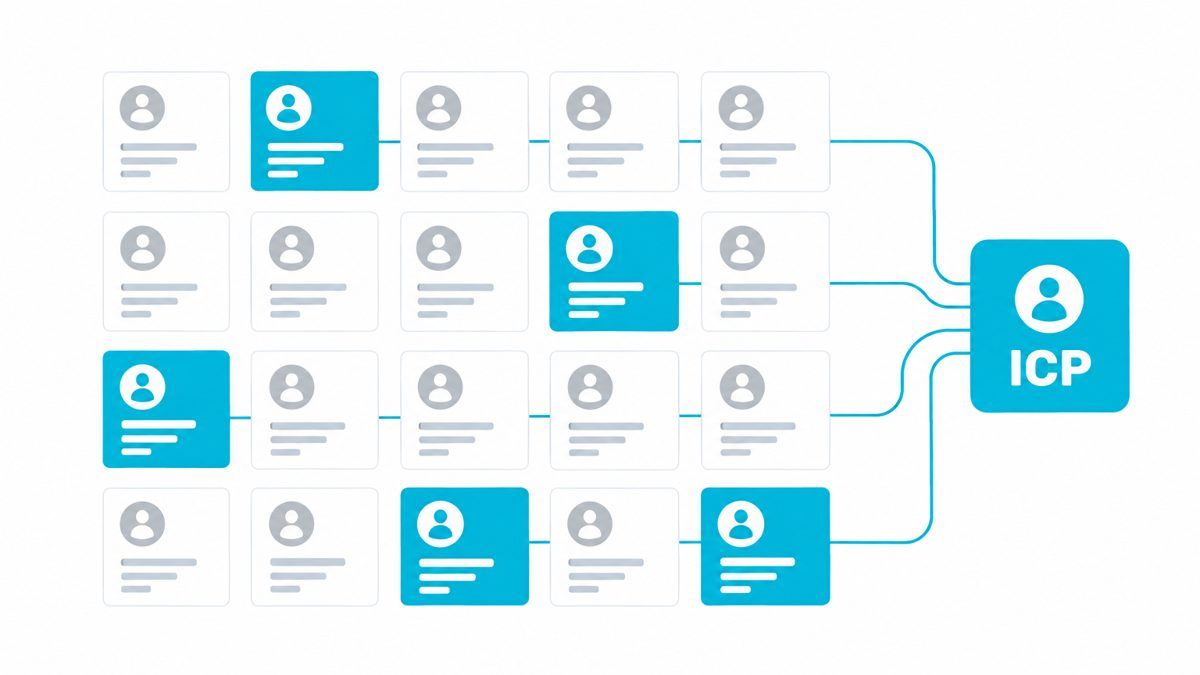
The fastest way to build an ideal customer profile template is to stop guessing and study the customers you already have. Pull your best 20 accounts, score them on revenue, retention and speed to close, then write down only the traits most of them share. What comes out is a one-page ICP grounded in evidence, not a whiteboard session.
This guide walks through that process step by step, gives you a fill-in ideal customer profile template you can copy into a doc or spreadsheet, and shows a finished example for a B2B SaaS company.
What is an ideal customer profile?
An ideal customer profile (ICP) is a description of the type of company that gets the most value from your product and gives you the most value back. It describes accounts, not people. Firmographics (industry, size, stage), technographics (tools they run), triggers (events that create urgency) and disqualifiers all live in it.
It is not a buyer persona. A persona describes the human who signs or champions the deal. You need both, but the ICP comes first, because it decides which companies are worth finding personas inside.
It is also not your total addressable market. Your market is everyone who could buy. Your ICP is the slice that buys fast, stays long and expands.
Why build it from your best 20 customers?
Twenty is enough to see patterns and small enough to research by hand in an afternoon. Most early ICPs fail because they describe who the founders hope will buy. Your closed-won data describes who actually did.
It also fixes a common gap. A HubSpot survey of more than 300 marketers, reported by Customer Impact in 2026, found only 48% had a formally documented ICP. If your ICP lives in someone's head, every rep, ad and sequence targets a slightly different company.
Step 1: How do you pick your best 20 customers?
Rank every paying account on four signals and take the top 20. Do not pick by gut or by logo prestige.
Signal | What to pull | Score 1 to 5
Revenue | Current ARR or annual contract value | 5 = top 20% of accounts
Retention | Months active, renewals, churn risk | 5 = renewed at least once, healthy usage
Speed to close | Days from first touch to signed | 5 = fastest 20% of deals
Expansion and advocacy | Upsells, seats added, referrals, reviews | 5 = expanded and referred
Add the four scores. Anything 16 or above is a strong candidate. If you have fewer than 20 customers, use all of them and weight retention highest, since early revenue is noisy.
Practitioner tip: also pull your 5 worst customers (churned fast, heavy support load, discounted hard). You will use them in Step 4 to write disqualifiers, which is the part most ICP templates skip.
Step 2: What data should you collect on each account?
Collect the same 12 fields for every one of the 20, in one spreadsheet row per account. Consistency matters more than depth.
- Industry and sub-vertical
- Employee count at time of purchase
- Funding stage or revenue band
- Headquarters region
- Business model (sales-led, product-led, hybrid)
- Go-to-market team size (sales, SDR, marketing headcount)
- Key tools in their stack (CRM, data, outreach, analytics)
- Who found you and who signed (titles)
- The trigger: what happened in the 90 days before they bought
- The problem they described in their own words on the first call
- Alternatives they considered, including doing nothing
- First value: what result they saw and how fast
Fields 9 and 10 are the most valuable and the hardest to get. Pull them from call recordings, CRM notes or a 15-minute call with the champion. Copy their exact words; you will reuse them in messaging.
Step 3: How do you find the patterns?
Count how often each value appears across the 20 rows, and keep any trait shared by 14 or more accounts (about 70%). Traits shared by 10 to 13 go into a "strong signal" column. Anything below that is noise for now.
Use simple tallies, not averages. An average employee count of 85 hides the fact that half your best customers have 30 people and half have 150. Ranges and clusters tell you more.
Watch for the trigger pattern in particular. If 15 of 20 accounts bought within a quarter of raising a round, hiring their first sales rep or launching a new product, that trigger is worth more than any firmographic filter, because it tells you when to reach out, not just who.
Step 4: How do you write disqualifiers?
Compare your 5 worst customers against the 20 best and list what the worst share that the best do not. Those become hard "do not target" rules.
Typical disqualifiers for B2B SaaS look like: no dedicated owner for the workflow, fewer than a set number of employees, a procurement process longer than your runway can tolerate, or a stack that blocks your integration. Writing these down saves more pipeline time than any positive criterion, because it stops reps from chasing deals that close and then churn.
Step 5: Fill in the ideal customer profile template
Copy this template and fill each field with what you found in Steps 3 and 4. Keep it to one page.
Section | Field | Your answer
Firmographics | Industry / sub-vertical | [ ]
Employee range | [ ] to [ ]
Stage or revenue band | [ ]
Regions | [ ]
Go-to-market | Business model | [ ]
Team shape (sales, SDR, marketing) | [ ]
Technographics | Must-have or common tools | [ ]
Triggers | Events in the last 90 days that predict a purchase | [ ]
Where you can observe them (job posts, funding news, launches) | [ ]
Problem | The pain in the customer's own words | "[ ]"
Cost of doing nothing | [ ]
Buying group | Who finds you | [ ]
Who signs | [ ]
Value | First result and time to reach it | [ ]
Disqualifiers | Hard no rules | [ ]
Evidence | How many of the best 20 match this profile | [ ] of 20
The evidence row keeps you honest. If your finished profile only describes 8 of your 20 best accounts, it is too narrow, or you actually have two ICPs and should split them.
What is an ideal customer profile example?
Here is a filled-in example for a hypothetical B2B SaaS company selling a sales analytics tool. The numbers are illustrative, to show the level of specificity to aim for.
Field | Example answer
Industry | B2B SaaS, horizontal or vertical software
Employee range | 30 to 150
Stage | Seed to Series B
Regions | North America, UK
Business model | Sales-led or hybrid, average deal above a set threshold
Team shape | 2 to 10 sales reps, first or second sales leader in seat
Technographics | Runs a mainstream CRM, uses a call recorder
Triggers | Raised a round in last 6 months; posted an SDR or sales ops job; new VP of Sales hired
Problem (their words) | "We hit the number last quarter and I still can't tell you why."
Cost of doing nothing | Missed forecast, board asks questions the team cannot answer
Who finds you | Head of Growth or RevOps lead
Who signs | CEO or VP of Sales
First value | First pipeline report within the first week
Disqualifiers | Fewer than 2 reps; no CRM; procurement over 90 days
Evidence | 16 of best 20 match
Notice what makes it usable: every field can be checked against public data or a single discovery question. "Innovative, growth-minded companies" fails that test. "Posted an SDR job in the last 6 months" passes it.
Step 6: How do you put the ICP to work?
An ICP only pays off when it changes who you contact this week. Turn it into three concrete things.
- A target list. Translate firmographic and technographic fields into filters, then layer triggers on top so the list is ranked by timing.
- A fit score. Give each inbound lead and outbound account points for each matched field and subtract for disqualifiers. Route only high scorers to sales.
- Messaging. Lead outreach with the problem in your customers' own words from Step 2. It converts better than your own category language because it is how buyers describe the pain to themselves.
Once the profile is written, the bottleneck becomes execution: finding every matching account, watching for triggers and reaching out on time. If you want that part to run on its own, 10ex deploys autonomous agents that take your ICP, build and enrich the list, monitor buying signals and book meetings across channels.
How often should you update your ICP?
Revisit it every quarter, and rebuild it from scratch whenever your best 20 list changes by more than a quarter of its accounts. New product lines, a pricing change or moving upmarket will all shift who your best customers are. Rerun Steps 1 to 4 with fresh data and compare the evidence row to the last version.
FAQ
What is an ideal customer profile example?
An ideal customer profile example is a filled-in template describing a specific type of company, such as "Seed to Series B B2B SaaS, 30 to 150 employees, 2 to 10 sales reps, recently raised or hiring SDRs." The example table above shows every field completed.
What should an ideal customer profile template include?
At minimum: firmographics, go-to-market shape, technographics, buying triggers, the problem in the customer's words, the buying group, time to first value, disqualifiers and an evidence count showing how many best customers match.
How many customers do I need to build an ICP?
Twenty is a practical target. With fewer, use every paying customer and treat the result as a draft. With many more, still start with the top 20 by score, then validate against the next 50.
What is the difference between an ICP and a buyer persona?
An ICP describes the company that fits best. A buyer persona describes the person inside that company who finds, champions or signs the deal. Build the ICP first.
Can a company have more than one ICP?
Yes. If your best 20 split into two clear clusters, for example small product-led teams and larger sales-led teams, write two profiles and give each its own list, score and messaging.