Marketing
How to Book More Sales Meetings in 2026: A 7-Step Playbook
Nikhil Adiga · · 6 min read
On this page
- What does "good" look like for booked meetings in 2026?
- Step 1: Shrink the list to buyers with a live reason to talk
- Step 2: Write the first email around their trigger, not your product
- Step 3: Follow up five to seven times, because that's where the replies are
- Step 4: Add a second channel to every sequence
- Step 5: Remove friction from the moment someone says yes
- Step 6: Turn more conversations into meetings
- Step 7: Measure the funnel weekly and fix the weakest stage
- Fill-in sequence template
- Running this without hiring a team
- FAQ
How to book more sales meetings: send fewer messages to better-timed buyers, follow up five to seven times across at least two channels, and ask a question that is easy to say yes to. Most teams don't have a volume problem. They have a targeting, follow-up and friction problem, and each one can be fixed in a week.
This guide is for B2B SaaS founders and heads of growth running outbound with a small team. It covers the 2026 benchmarks you should measure against, a seven-step process, a fill-in sequence template, and the mistakes that sales forums keep complaining about.
What does "good" look like for booked meetings in 2026?
A healthy cold program converts roughly 1.5–2% of contacted prospects into meetings, according to a 2026 outbound benchmark from B2B News Network. Reply rates have been falling: Belkins reported a 5.8% average cold-email reply rate in 2024, down from 6.8% in 2023, and Visionary Marketing's 2026 study of 28,400 leads across 47 B2B programs found an average of 2.1%.
Definitions differ between studies (a "reply" can include "unsubscribe me"), so use these as ranges, not targets. The useful takeaway: if you contact 1,000 people a month, expect somewhere around 15–20 meetings from a decent program. If you're well below that, one of the steps below is broken.
| Metric | Benchmark | Source |
|---|---|---|
| Cold-email reply rate | 5.8% (2024), down from 6.8% | Belkins, 2024 |
| Cold-email reply rate | 2.1% average | Visionary Marketing, 2026 |
| Reply rate on first email | 1.18%, falling to 0.33% by email seven | Smartlead, 2026 |
| Cold outreach to meeting | 1.5–2% | B2B News Network, 2026 |
| Conversations that become meetings | 4.6% average, 16.7% top quartile | Gong Labs, 2024 |
| Share of replies from follow-ups | 58.6% | Belkins, 2026 |
Step 1: Shrink the list to buyers with a live reason to talk
The fastest way to book more meetings is to stop emailing people who have no reason to need you this quarter. A reply rate of 2% means 98% of your sends are noise, and that noise also burns domain reputation.
Filter by a trigger, not just a title. Good triggers for SaaS outbound:
- A job post for the role your product replaces or supports (for example, a first SDR hire).
- New funding in the last 90 days.
- A new leader in the buying seat (new VP of Sales or Head of Growth in the last 60 days).
- Public complaints or questions about the problem you solve on forums or LinkedIn.
What to do: cap each weekly list at the accounts that match at least one trigger, and write the trigger into the first line of the email. Verify every address before sending; bounces hurt every later campaign.
Step 2: Write the first email around their trigger, not your product
The first email should be short, name the trigger, and ask one easy question. Sales Reddit threads repeat the same lesson: emails that score well on writing tools still fail when they open with the sender's product.
Use this structure, under 90 words:
- Trigger: "Saw you're hiring your first two SDRs."
- Problem it implies: "Usually that means pipeline is the bottleneck and ramp time is 3+ months."
- One proof point: a specific, verifiable result or approach.
- Easy question: "Is pipeline the constraint this quarter, or is it something else?"
Open-ended questions beat yes/no asks for starting a conversation. Ask for an opinion before you ask for 30 minutes.
Step 3: Follow up five to seven times, because that's where the replies are
Most of your meetings will come from follow-ups, not the first email. Belkins' 2026 study found follow-ups generated 58.6% of all replies. Smartlead's 2026 State of Cold Email data, drawn from 850 million emails, shows the cumulative effect: three-email sequences produced about 25 replies per 1,000 contacts, five produced 33, and seven produced 40.
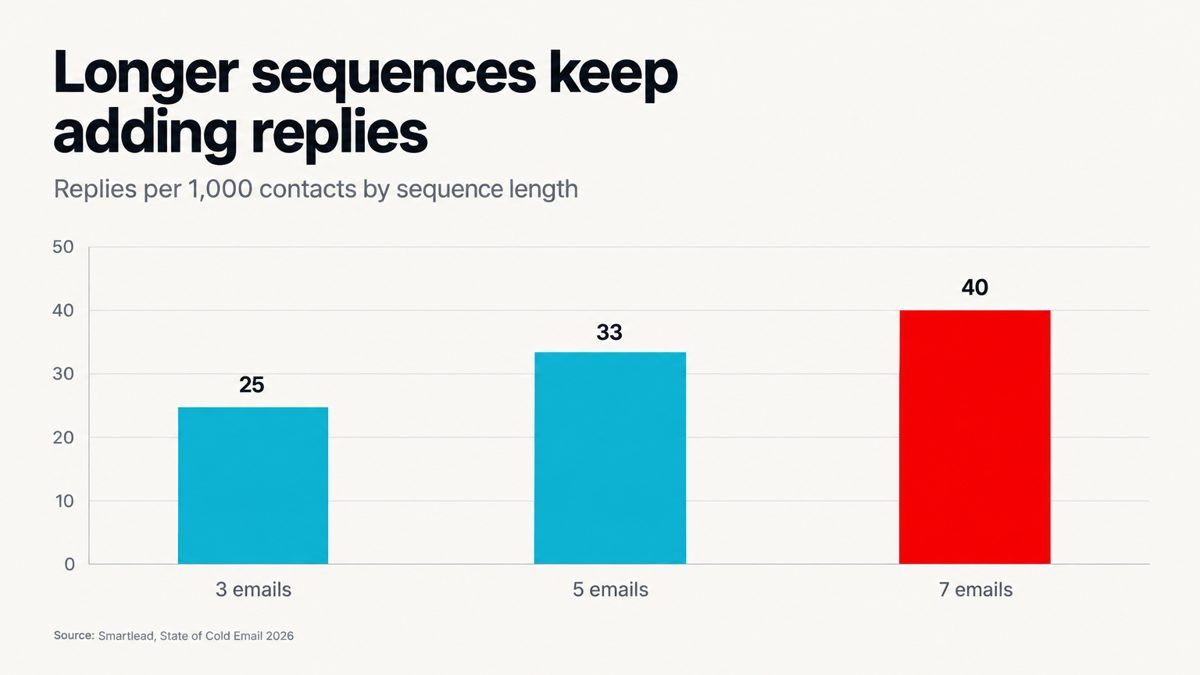
The same data showed diminishing returns after the fourth email, so each later touch needs a new angle rather than "just bumping this." What to do: plan five to seven touches over about three weeks, and give each one a different job: a useful resource, a short case, a peer question, a breakup note.
Step 4: Add a second channel to every sequence
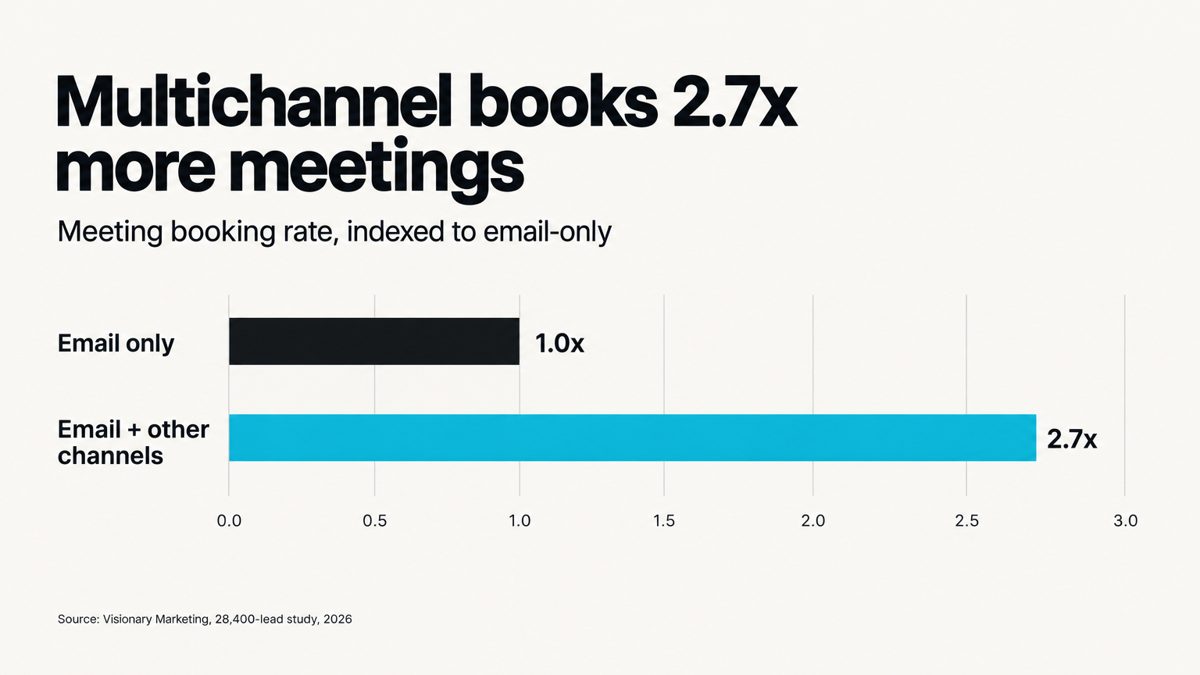
Email alone leaves meetings on the table. Visionary Marketing's 2026 study found multichannel sequences booked meetings at 2.7x the rate of email-only sequences, and a Belkins benchmark reported by B2B News Network in 2026 put the reply lift at two to three times.
The second channel doesn't need to be a phone call. A LinkedIn connection with no pitch, a comment on the prospect's post, or a helpful answer in a community thread they're active in all count. What to do: put a LinkedIn touch on day 1 or 2 and a second social touch mid-sequence, so your email name looks familiar when it lands.
Step 5: Remove friction from the moment someone says yes
Every extra round of "what time works for you?" costs you meetings. Once a prospect replies with interest, the next message should contain two specific time options plus a booking link, and a one-line agenda.
Speed matters for inbound too. The best-known evidence is old but consistent: Harvard Business Review's 2011 study of 1.25 million leads found that firms responding within an hour were nearly seven times more likely to qualify the lead than those that waited longer. What to do: answer positive replies and demo requests within the hour, during business hours, every day.
Step 6: Turn more conversations into meetings
A reply is not a meeting. Gong Labs' 2024 analysis of more than 300 million calls found 4.6% of conversations become meetings on average, while the top quartile hit 16.7%. That gap is mostly handling, not luck.
Handle the three common replies with prepared answers:
- "Send me more info." Send one short link and ask one question about their situation, so the thread stays a conversation.
- "Not right now." Ask what would change that and when, then set a reminder for that date.
- "We use X already." Ask what they'd change about it. That answer is your meeting agenda.
Step 7: Measure the funnel weekly and fix the weakest stage
Track four numbers every week: contacts reached, reply rate, positive-reply rate, and meetings held. Fix the lowest-performing stage first, one change at a time.
| If this is low… | Likely cause | Fix first |
|---|---|---|
| Delivered / opened | Bad data or poor sender reputation | Verify emails, warm domains, cut volume per inbox |
| Reply rate | Weak trigger or product-first copy | Rewrite line one around the trigger |
| Positive replies | Wrong persona or wrong timing | Tighten list filters |
| Meetings booked | Scheduling friction or slow responses | Two time slots + link, respond within an hour |
| Meetings held | No-shows | Calendar invite with agenda, reminder the morning of |
Fill-in sequence template
| Day | Channel | Job of this touch | Your line |
|---|---|---|---|
| 1 | Connect, no pitch | [Connection note referencing trigger] | |
| 2 | Email 1 | Trigger + easy question | [Trigger] → [Implied problem] → [Question] |
| 5 | Email 2 | Useful resource | [One link that helps even if they never buy] |
| 8 | Engage with their content | [Comment on a recent post] | |
| 11 | Email 3 | Short proof | [Specific, verifiable result or approach] |
| 15 | Email 4 | Peer question | "How are other [role]s handling [problem]?" |
| 21 | Email 5 | Breakup | "Should I close the loop on this?" |
Running this without hiring a team
The playbook above is simple on paper and tedious in practice: watching triggers, verifying data, writing personal first lines, running two channels and replying within the hour, every day. That's the work 10ex's autonomous agents take on, from finding buyers with live signals to booking the meeting on your calendar. If you'd rather run the process than staff it, see how 10ex runs it end to end.
FAQ
How to book more meetings in sales?
Target accounts with a live trigger, open with that trigger and an easy question, follow up five to seven times across email plus a second channel, and make booking a one-step reply. Then measure each funnel stage weekly and fix the weakest one.
How many follow-ups does it take to book a meeting?
Plan for five to seven. Smartlead's 2026 data showed replies per 1,000 contacts rising from 25 at three emails to 40 at seven, and Belkins' 2026 study attributed 58.6% of replies to follow-ups.
What is a good meeting booking rate for cold outreach?
Around 1.5–2% of contacted prospects, per B2B News Network's 2026 benchmark. Treat it as a range; definitions vary between studies.
What is the 3 3 3 rule in sales?
It's used in different ways, but a common version is: spend three minutes researching a prospect, find three relevant facts, and craft one opening line from them. The principle that matters for booking meetings is the same: a specific reason for reaching out beats a generic pitch.
Does multichannel outreach really book more meetings?
Yes, in the 2026 data available. Visionary Marketing's study of 28,400 leads found multichannel sequences booked meetings at 2.7x the rate of email-only.