Marketing
Why Google-Era Marketing No Longer Works (and How to Book Meetings in the Age of AI)
Nikhil Adiga · · 6 min read

Google-era marketing no longer works because buyers don't click through to your site any more. They read the answer on the results page or in a chatbot, and they make a shortlist before they ever talk to sales. To book meetings now, you have to show up in AI answers, spot buying signals early, and reach out within hours, with a message about the problem the buyer already has.
For fifteen years the playbook was simple: rank for keywords, gate a PDF, nurture the lead, hand it to an SDR. Each step assumed the buyer would arrive at your website and raise a hand. Both of those assumptions are breaking at once.
What was Google-era marketing?
Google-era marketing was a funnel built around the click. You published content to rank, traffic arrived, forms turned visitors into leads, and sales worked the leads in order. Traffic was the leading indicator, and more of it meant more meetings a quarter later.
It worked because search was the front door to every B2B purchase. Buyers had to visit vendor sites to learn anything, so the vendor controlled the first conversation.
Why are clicks from search disappearing?
Most searches now end without a visit to any website. SparkToro and Datos found in 2024 that 58.5% of US Google searches ended with no click at all, and 59.7% in Europe. Ranking first for a keyword now gets you a smaller share of a smaller pool.
AI summaries make it worse. In a 2025 study, Pew Research Center found that users clicked a traditional result on 8% of visits when an AI Overview appeared, compared with 15% without one. Only 1% clicked a link inside the AI Overview itself.
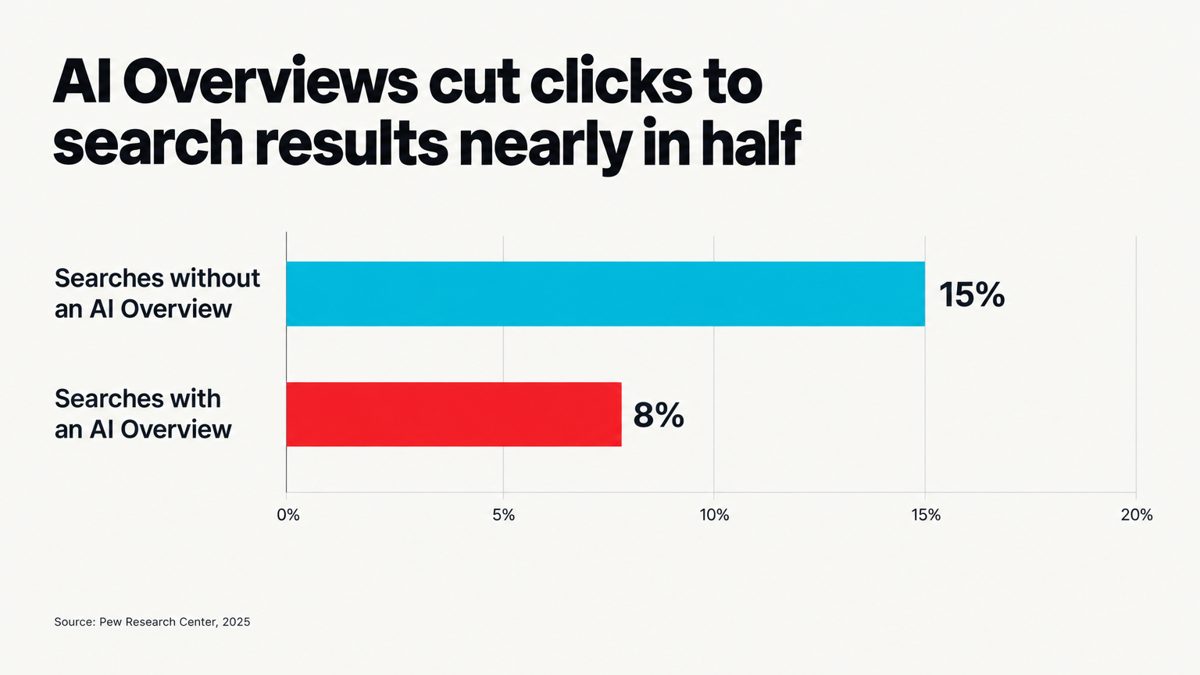
If your pipeline model starts with "sessions," it's tracking a number that is falling for reasons unrelated to how good your content is.
Where do B2B buyers research software now?
A growing share of buyers start in a chatbot, not a search box. G2 reported in 2026 that 51% of B2B software buyers begin their purchasing process in an AI chatbot, and 63% use ChatGPT for research. The chatbot reads your content, but the buyer may never see your page.
That changes what content is for. A blog post used to be a landing page. Now it's source material that an AI reads, summarizes and either cites or ignores. Clear answers, specific numbers and plain comparisons get quoted. Long intros written to rank for a keyword don't.
Why does the buyer pick a vendor before talking to you?
Buyers finish most of their decision on their own and arrive with a favorite. The 6sense 2024 Buyer Experience Report found that 81% of buyers already had a preferred vendor when they first spoke with a sales rep. Gartner's survey of 632 buyers, conducted in 2024 and published in 2025, found 61% prefer a buying experience with no rep at all.
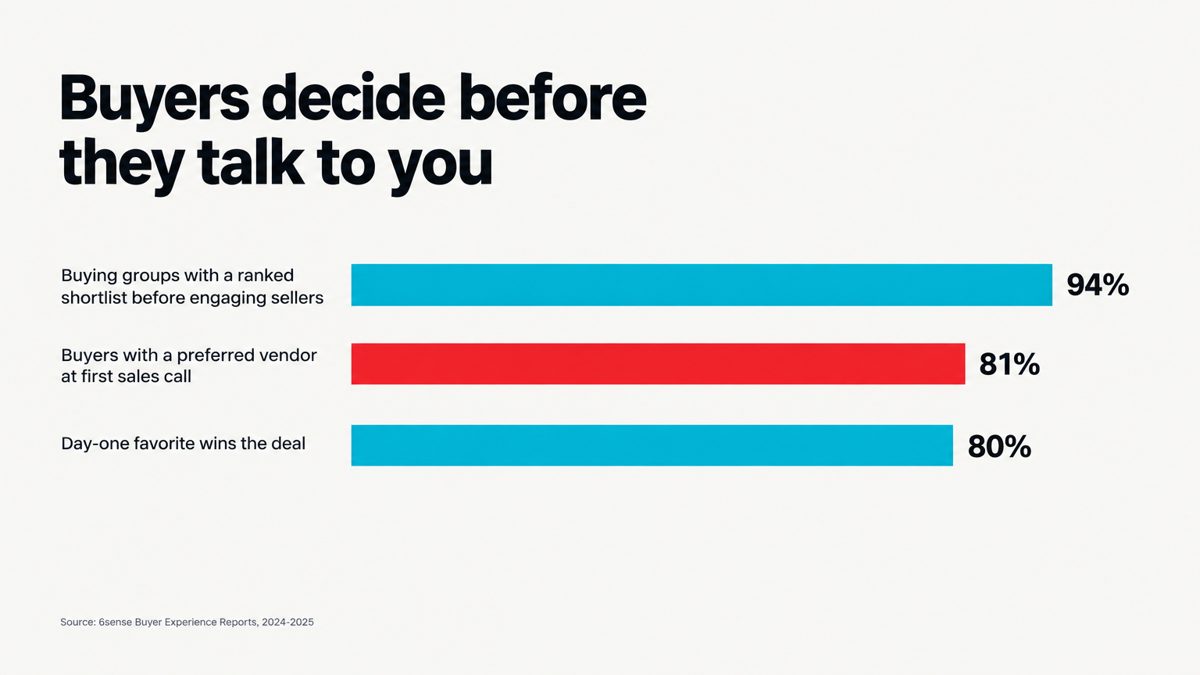
So the old sequence has the order wrong. By the time an inbound form arrives, the shortlist is mostly done. If you only start the conversation when they fill out the form, you're usually competing for second place.
What still works from the old playbook?
Good content still matters. What's changed is how it pays off. Useful, specific writing still builds trust and still gets read, now mostly by AI models and by buyers who already know your name. What no longer works is treating traffic as the goal and the form fill as the start of the relationship.
| Google era | AI era |
|---|---|
| Rank for keywords | Get cited in AI answers |
| Measure sessions | Measure meetings and cited mentions |
| Wait for the form fill | Act on buying signals before the form |
| Generic nurture sequence | One message about one live problem |
| Work leads in order received | Respond within hours, ranked by intent |
How do you book meetings in the age of AI?
You book meetings by reaching the buyer while they're still forming the shortlist, with proof they can check. Here's a five-step system.
1. Write content to be quoted, not just to rank
Open every post with a two-to-three sentence answer. Make headings plain questions. Put real numbers, with sources, in the text. Add a table or a template. AI engines pull these pieces directly, and buyers who click through get to the answer fast. Track whether chatbots name you for your core category questions, and fix the pages they skip.
2. Watch for buying signals, not traffic
The useful signal comes before the form. Examples include a company posting an SDR job, a new head of growth starting, a founder asking a peer community which tool to use, or a funding round. Each of these is a public, timed event that tells you a problem is live right now. Build a list of the five signals that most often come before your closed deals, and check them daily.
3. Show up where buyers ask each other
Buyers who don't want a rep still ask peers. Communities like Reddit threads and LinkedIn comments are where shortlists get formed and also where AI models learn which products to recommend. Answer the question that was asked, give the full answer for free, and mention your product only when it actually fits.
4. Reach out within hours, about one problem
When a signal fires, the message should name the trigger and a single problem it creates. For example: "You posted two SDR roles this week. Most teams at your stage spend the first 90 days ramping them. Here's what it looks like to have pipeline running by Monday instead." One problem, one ask, no deck attached. A signal that's a week old is already somebody else's meeting.
5. Measure meetings, not activity
Replace sessions and MQLs on your dashboard with three numbers: meetings booked, time from signal to first touch, and how often AI answers mention you for your top five category questions. If those three go up, pipeline goes up, whatever your traffic graph says.
Can a small team actually run this?
Yes, but not by hand. Checking signals daily, answering community threads, writing pages that get cited and following up within hours is more work than a two-person growth team can do. That's the job autonomous agents are good at. They watch the signals, draft and send the outreach, publish the content and book the meeting on the calendar. If you want to see this running on your own market, try 10ex and let the agents book your next meetings.
FAQ
Is SEO dead?
No, but its job has changed. Search still sends buyers, just fewer clicks per search: SparkToro and Datos measured 58.5% zero-click US searches in 2024. Write content so it gets quoted by AI answers, and measure what it does for meetings, not traffic.
Why doesn't Google-era marketing work anymore?
Its two core assumptions broke. Buyers no longer need to click to get answers, and they pick a favorite vendor before talking to sales. The 6sense 2024 report found that 81% of buyers had already done so.
How do I get my company cited by ChatGPT and other AI tools?
Publish direct answers, sourced numbers, comparison tables and FAQs on pages with plain question headings. Get mentioned in the communities and reviews that AI models read. Then check every month whether chatbots name you for your core questions.
What's the fastest way to book B2B meetings in 2026?
Act on public buying signals such as hiring, funding and leadership changes within hours, with a short message tied to that trigger. Speed and relevance beat volume.
What should replace MQLs as a metric?
Meetings booked, time from signal to first touch, and how often AI answers mention you. All three track what buyers actually do now.