Marketing
What It Takes to Earn a Reply: The Cold Email Response Rate Formula (2027)
Nikhil Adiga · · 15 min read

On this page
- What does it take to earn a reply to a cold email?
- What is the reply formula?
- Why do accounts (A) matter more than copy?
- What makes an account a fit (f)?
- How many touches (t) should a cold sequence have?
- How do you get delivered (d)?
- How do you earn attention (a)?
- What drives response (r)?
- Why do replies still fail to become meetings (q, m)?
- How do you make sure booked meetings are held (h)?
- Does timing (E) really change reply rates?
- How do you use the formula to raise your cold email response rate?
- What does a good cold email reply rate look like?
- What does an email that passes all three decisions look like?
- FAQ
Your cold email response rate is earned in three quick decisions and capped by ten variables. The reader decides whether to open, whether to read and whether to reply. Each decision takes seconds, and every one has to go your way. A meeting only happens when every variable in the chain, from the accounts you pick to the week you send, is in the green. If one is weak, it caps everything after it.
The bar is simple to say and hard to meet: the reader should be glad he opened it. If he is, he replies. If he isn't, no subject-line trick or follow-up cadence will save the send.
This post sets out the model we use. First come the three decisions, then the full meeting formula with what good looks like for each variable, and then how to diagnose and fix a sequence one variable at a time. At the end you'll find benchmarks for a good cold email reply rate and a FAQ.
What does it take to earn a reply to a cold email?
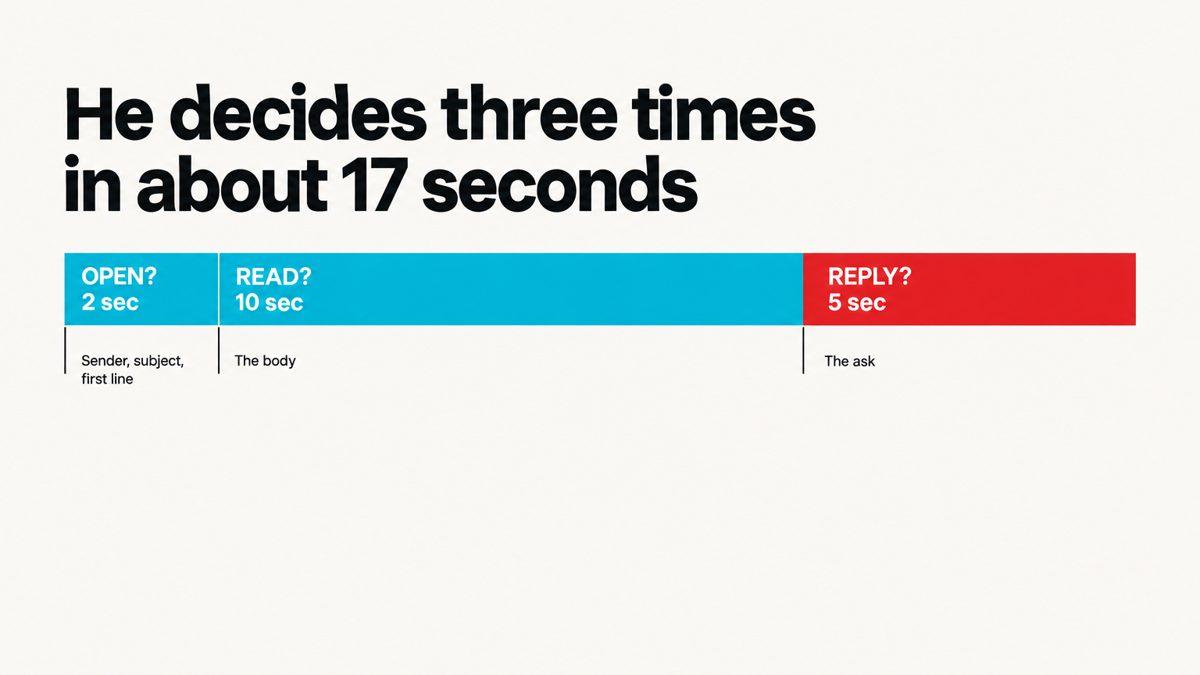
It takes three yeses in a row: he opens it, he reads it, and he answers it. Each happens in a few seconds, and each depends on different things. Treat them as one problem ("write a better email") and you end up fixing the wrong part.
Here is the working model. The timings are rough budgets, not measured averages. They are a way to think about how little attention you get at each step.
| Decision | Time budget | What he sees | Good means |
|---|---|---|---|
| Open? | ~2 seconds | Sender, subject, first line | A person, a subject about him, and a line no one else (and no generic automation) could have written |
| Read? | ~10 seconds | The body | Something new, about a problem he owns, from someone believable |
| Reply? | ~5 seconds | The ask | A question he can answer from memory, plus something for him |
Open: does this look like it's for me?
In the inbox he sees three things: who sent it, the subject, and the preview of the first line. That's all the evidence he has. He's asking one question: is this a person writing to me, or a system writing to a list? A name he could picture as a peer, a subject about his world rather than your product, and a first line that obviously required knowing something about him all say "person". "Quick question", "{FirstName}, partnership opportunity" and "I hope this finds you well" all say "list".
Read: is this worth ten seconds?
Once he opens it, he skims. He's checking whether the email tells him something he didn't know, about a problem he actually owns, from someone with a reason to know it. If the body is about you (your company, your funding, your features), he stops. If it's about a change in his business and what that change usually causes, he keeps going.
Reply: can I answer this without thinking?
Replying costs effort, so the ask has to cost almost nothing. "Would you be open to a 30-minute call next week?" asks him to check a calendar, judge you, and commit time. "Is outbound still owned by you, or did that move to the new VP?" can be answered from memory in five words. Pair the question with something he gets regardless (a benchmark, a teardown, a short list), and replying stops being a favor to you.
What is the reply formula?
The reply formula says meetings held are a product, not a sum. Written out:
Meetings held = A × f × t × d × a × r × q × m × h × E
Because the terms multiply, a zero anywhere gives zero everywhere. A brilliant email sent from a domain that lands in spam produces nothing. A perfect inbox placement to accounts with no live problem produces polite silence. You can't make up for a broken variable by over-investing in a healthy one.
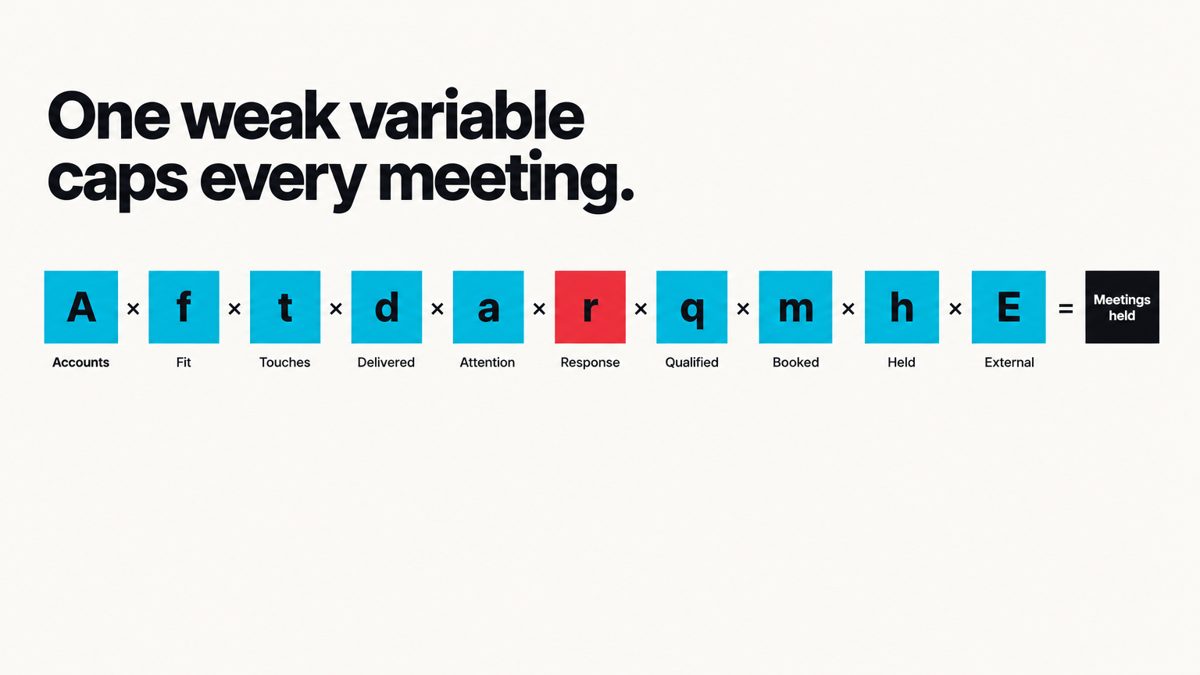
| Variable | Plain meaning | What it measures | What good looks like |
|---|---|---|---|
| A | Accounts | How many we target | Accounts facing the problem right now: a live, dated reason, not just a title match |
| f | Fit share | Share of the list that fits the ideal customer | Accounts that look like customers who already bought and got value: same size, stack and industry, with nothing ruling them out |
| t | Touches | Emails per person | Every touch brings something new, a fact or an angle, never a reminder. Three follow-ups, then stop |
| d | Delivered | Share that reaches an inbox | A sender inbox providers trust: authenticated, warmed and sending low volume |
| a | Attention | Share a human opens | A peer he would recognize, with a subject and first line that are plainly about him |
| r | Response | Share that replies | A reason only he has, right now, and a question he can answer from memory |
| q | Qualified | Share of replies that are the right people and interested | Replies from the person who owns the problem and the budget |
| m | Booked | Share of those that agree to talk | He gets value before he is asked for time: what was promised arrives first |
| h | Held | Share of booked meetings that happen | The meeting is about his problem and happens soon, so it is still worth his time on the day |
| E | External | Season and market | Timing that fits his calendar: budget season and renewals, not holidays or quarter-end |
The rest of this post walks through each variable in the order it happens, then shows how to use the formula to find and fix the weakest one.
Why do accounts (A) matter more than copy?
Because no sentence can make a problem exist. The most common reason a well-written email gets no reply is that the reader doesn't have the problem this quarter. A title match ("Head of Growth at a Series A SaaS company") tells you who could care. A dated reason tells you who cares now.
A dated reason is something that happened, with a date on it, that makes your problem more likely to be live. Examples:
- They posted their first SDR job in the last 60 days.
- They raised a round last month and announced a revenue target.
- They hired a new VP of Sales who will rebuild outbound in their first 90 days.
- They launched in a new region and have no pipeline there yet.
- Their head of growth posted publicly about missing a pipeline number.
What to do: build A from triggers first and titles second. A list of 200 accounts with a dated reason will beat a list of 2,000 title matches on every downstream variable, because r, q and m all lean on that reason.
What makes an account a fit (f)?
Fit means the account looks like the customers who already bought and got value. "Got value" is the important bit. Pull your best five to ten customers, the ones who renewed, expanded or would happily take a reference call, and note what they share: headcount band, stage, tools in the stack, industry, the motion they sell with.
Then write down the disqualifiers, which matter just as much. A company that sells only through channel partners, one locked into a three-year contract with an alternative, or one with no one in the role you sell to will never convert, however good the email is.
What to do: score every account on fit before it gets a single email. Anything with a hard disqualifier comes off the list. A low f looks like "lots of replies, no meetings", which teams often misread as a copy problem.
How many touches (t) should a cold sequence have?
Four emails: the opener plus three follow-ups, each adding something new. Then stop. The data supports following up. In Instantly's Cold Email Benchmark Report 2026, built on 2025 sending data, the first email produced 58% of replies and the follow-ups produced the other 42%. Stop after one send and you leave a large share of possible conversations unopened.
The rule that matters is new information per touch. "Just bumping this" asks him to do the work of rereading your first email. A follow-up should carry a new fact, a new angle or a new offer:
- Touch 2: a specific piece of evidence, for example how a similar company handled the same trigger.
- Touch 3: a different angle on the same problem, such as cost, risk or speed instead of growth.
- Touch 4: a clean close that makes "not now" an easy reply.
We cover spacing, angles and templates for each step in How to Write a Cold Email Follow Up Sequence That Gets Replies.
How do you get delivered (d)?
You get delivered by being a sender inbox providers trust: authenticated, warmed and sending low volume per inbox. If d is broken, every other variable reads as zero, and you'll blame the copy for a problem the copy never had a chance to fix.
The baseline:
- Authenticate every sending domain with SPF, DKIM and DMARC.
- Warm up new domains and inboxes over weeks before putting real volume through them.
- Send low volume per inbox and spread volume across several inboxes rather than pushing one hard.
- Verify every address before sending. Bounces damage your reputation for everyone else on the domain.
- Watch complaints. Google and Yahoo's bulk-sender requirements, in force since 2024, set a spam-complaint ceiling of 0.3%. Treat that as a hard limit and aim well below it.
Smaller, tighter sends also seem to help. Hunter's State of Email Outreach 2026 report, based on 2025 data, found a 6.2% reply rate for sequences sent to 21 to 50 recipients, against a 4.5% overall average. That doesn't prove small always wins, but it fits the pattern: a narrow, relevant list complains less, lands better and replies more.
How do you earn attention (a)?
You earn the open with a sender he'd see as a peer and a subject line about him. That is the full two-second decision.
The sender
A person's name from a real domain, ideally someone of a similar level. A founder writing to a founder, or a growth lead writing to a growth lead, reads as a conversation. A generic role address or a brand-only sender name reads as a campaign.
The subject line
Make it short, lowercase-normal and about his world. Name his trigger or his problem, not your product:
- Weak: "Scale your pipeline with AI"
- Weak: "Quick question"
- Better: "your first SDR hire"
- Better: "pipeline for the EMEA launch"
The first line
The preview text is the third thing he sees, so it has to prove the email was written for him. "I saw you posted an SDR role on the 4th, your first sales hire" passes. "I hope you're doing well" fails, because it could be in any email to anyone.
What to do: before you send, cover your company name and ask whether the sender, subject and first line could have gone to anyone else. If they could, he'll see that too.
What drives response (r)?
Response comes from a reason only he has, right now, and a question he can answer from memory. This is the variable most cold email advice is about, and it's usually where a sequence with healthy opens breaks.
Under r sit seven drivers you can score before sending. Score each 0, 1 or 2. Anything with a 0 doesn't go out.
| Driver | Question to ask | 0 = fails | 2 = strong |
|---|---|---|---|
| Who | Does this person own the problem? | Title match only | Named owner of the outcome you affect |
| Why now | Is there a dated reason? | None, or "companies like yours" | A specific event in the last 90 days |
| What's new | Will he learn something? | Describes your product | A fact, pattern or number he didn't have |
| Proof | Why believe you? | Adjectives ("leading", "best-in-class") | A concrete, checkable example |
| Sender | Would he see a peer? | Brand or generic role | A recognizable person at his level |
| Offer | What does he get either way? | Nothing until he books | Something useful, free of commitment |
| Ask | Can he answer from memory? | "Open to a 30-min call?" | A yes/no or one-word factual question |
A reason only he has
The strongest emails couldn't have been sent to anyone else. "Teams that hire their first SDR usually spend the first quarter building the list rather than selling" is useful, but it's true of everyone. "You posted your first SDR role on the 4th. Teams at your stage usually spend that hire's first quarter building lists" is about him. The difference is one dated fact.
Something he didn't know
"What's new" is what earns the ten-second read. Good sources are patterns you've seen across many similar companies, a number from his own public data he may not have put together, or a specific risk tied to his trigger. Your features are not new to him. They're just new.
A question he can answer from memory
Compare:
- "Would you be open to a quick call to explore synergies?" (He has to decide whether he likes you.)
- "Is the new SDR going to build their own list, or will that land on you?" (He already knows the answer.)
The second one gets answered because it costs nothing to answer. Once he's answered, you're in a conversation, and booking time is a natural next step instead of a cold ask.
Why do replies still fail to become meetings (q, m)?
They fail because the replies come from the wrong person, or because you asked for time before giving anything. Those are two separate variables, and they need separate fixes.
Qualified (q)
A good q means the replies come from the person who owns the problem and the budget. If you're getting "not me, try Sarah" or "we're not looking at this", the problem sits upstream: wrong person (who) or wrong account (A, f). Count referrals and "not a fit" replies separately from real interest, or q will flatter you.
Booked (m)
A good m means he gets value before he's asked for time. If you offered a teardown, a benchmark or a list, send it first, in full, with no gate. Then ask whether it's worth twenty minutes to go through what it means for him. Delivering on the first promise is the best evidence you have that the meeting will be worth his time too.
How do you make sure booked meetings are held (h)?
Make the meeting about his problem and book it soon. A meeting booked three weeks out is a meeting that has gone cold by the time it arrives. His priorities have moved, and the reason he said yes has faded.
- Offer times within the next few working days.
- Put his problem in the calendar title, for example "Pipeline plan for EMEA launch" rather than "Intro call: [Your Company]".
- Send a two-line note the day before with the one thing you'll show him.
Does timing (E) really change reply rates?
Yes, because his calendar decides whether he has room to care. E covers what you can't control but can plan around: budget season, renewal windows, holidays and quarter-end. A head of sales in the last week of the quarter is closing deals, not taking calls about next year's pipeline. The same email in the first two weeks of a new quarter, when plans are being set, lands very differently.
What to do: map your buyers' calendars. Send when budgets are being decided and renewals are being reviewed. Avoid major holidays and the last ten days of a quarter. Don't run an experiment across a holiday and credit the result to your copy.
How do you use the formula to raise your cold email response rate?
Fix the first broken variable first, change one variable per send, and score the r drivers before anything goes out. Three rules:
1. Fix the first broken variable first
Work in order. If people aren't opening, nothing about the copy can be judged yet, because nobody has read it. A diagnostic sequence:
| Symptom | Likely broken variable | First fix |
|---|---|---|
| High bounces, low opens across the board | d (Delivered) | Verify addresses, check authentication, cut volume per inbox |
| Delivered fine, few opens | a (Attention) | Peer sender, subject about him, specific first line |
| Opens fine, few replies | r (Response) | Score the seven drivers and fix every 0 |
| Replies, but mostly "not me" or "not a fit" | q, or f and A upstream | Tighten fit and target the problem owner |
| Interested replies, few meetings | m (Booked) | Deliver the promised value before asking for time |
| Meetings booked, many no-shows | h (Held) | Book sooner and name his problem in the invite |
| Everything dropped at once | E (External) | Check the calendar before you rewrite anything |
2. Score the drivers under r before sending
Who, why now, what's new, proof, the sender, the offer and the ask. Use the 0–2 table above on every variant. It takes two minutes and catches most weak emails before they cost you reputation.
3. Change one variable per send
If you change the list, the subject line and the ask in the same week and the reply rate doubles, you've learned nothing you can repeat. Change one thing, send to a comparable slice, and credit the result to that change. It's slower per test and much faster over a quarter.
What does a good cold email reply rate look like?
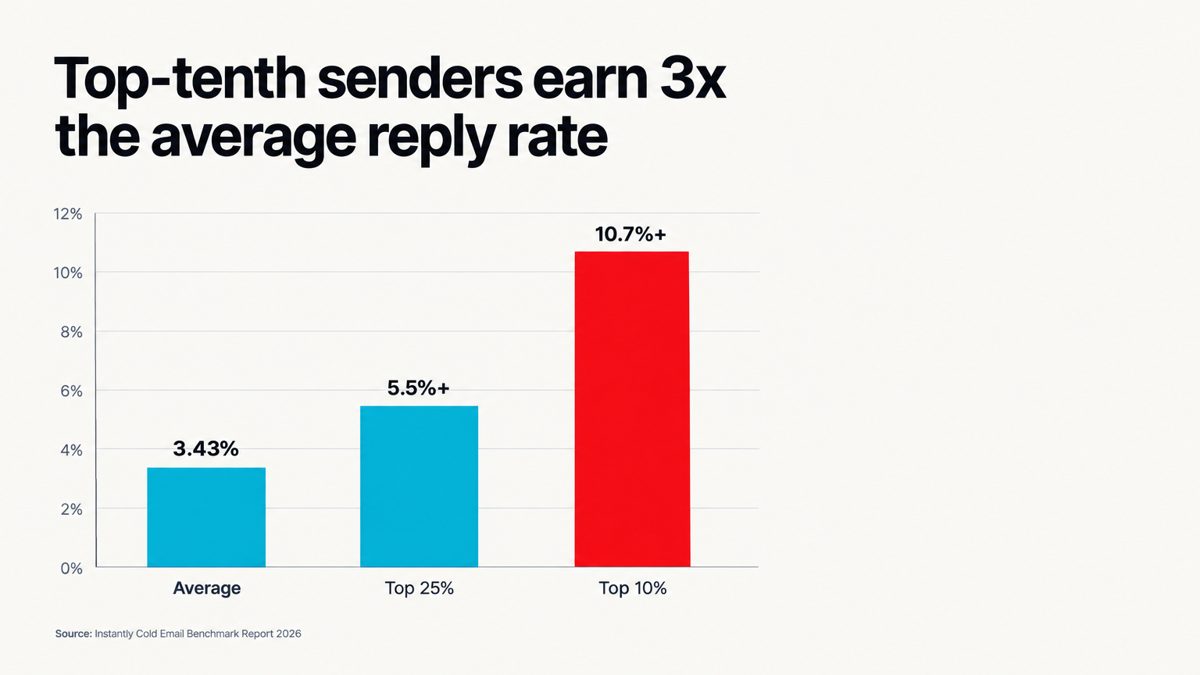
About 3.43% is average and 10.7% or more puts you in the top tenth, according to Instantly's Cold Email Benchmark Report 2026, which analyzed sending data from 2025. The same report puts the top quarter at 5.5% or more. Its reply rate counts all replies, including those to follow-ups, divided by emails sent.
Other studies report different numbers, mostly because they count differently:
| Source | Reply rate | What it counts |
|---|---|---|
| Instantly, Cold Email Benchmark Report 2026 (2025 data) | 3.43% average; 5.5%+ top 25%; 10.7%+ top 10% | All replies, including follow-ups, per email sent |
| Hunter, State of Email Outreach 2026 (2025 data) | 4.5% average; 3% for sales sequences; 6.2% at 21–50 recipients | Sequence reply rate |
| Smartlead, State of Cold Email 2026 (H1 2026) | 0.74% median; 2.63% top 10% | Median sender on the platform |
| Belkins (2025 data) | 0.45% | Unique replies per email sent, a stricter method |
How to read this: compare yourself against one benchmark using the same denominator you use. If you count replies per prospect and the benchmark counts replies per email, you'll look better or worse than you really are. More useful than any industry number is your own baseline. Measure it for one clean send, then improve it one variable at a time.
Also, a reply rate is not a meeting rate. A 10% reply rate made up of "unsubscribe" and "not me" is worse than a 4% rate made up of owners asking for the teardown. Track q and m next to r.
What does an email that passes all three decisions look like?
Here's one example, anonymized, with a note on which variable each line serves.
From: Dana Reyes, founder Subject: your first SDR hire (a: about him) Hi Marcus, you posted your first SDR role on the 4th. (r: why now, dated) At Series A, that hire usually spends their first quarter building lists rather than selling. Across the teams we've worked with, list-building ate most of the first 60 days. (r: what's new + proof) I put together a one-page version of the list-building playbook those teams wished they'd had on day one. Happy to send it either way. (r: offer, something for him) Is the new hire going to build their own list, or will that land on you? (r: ask, answerable from memory) Dana
It fits on a phone screen. It's about him from the first word to the last. The ask takes five seconds, and he gets the playbook whatever he answers.
Running this model by hand works for a few dozen accounts a week. Finding the dated reasons, checking fit, verifying addresses and writing a reason-only-he-has line for every account is where teams run out of hours. If you'd rather have agents do that research and outreach end-to-end, try 10ex and see what it books.
FAQ
How to write cold emails that actually get replies?
Write to one person about one dated reason they have right now, tell them something they didn't know, and end with a question they can answer from memory. Send it from a real person at a peer level, keep it short enough to read in about ten seconds, and offer something useful whether or not they book a meeting.
What is a good cold email response rate?
Instantly's Cold Email Benchmark Report 2026 puts the average at 3.43%, the top quarter at 5.5% or more, and the top tenth at 10.7% or more. Other studies report lower figures because they count unique replies or medians. Compare against a benchmark that uses the same method you do.
What is the 30/30/50 rule for cold emails?
It's shared online as a rule of thumb for balancing cold email effort, but we couldn't find a consistent definition or a reliable source for it. The reply formula in this post is a more useful check: find the first variable that's broken and fix that before anything else.
Is cold emailing illegal?
In many places B2B cold email is legal if you follow the local rules. These typically include identifying yourself honestly, avoiding misleading subject lines, including a working opt-out and honoring it, and having a legitimate reason to contact the person. Rules vary by country, so check the requirements where your recipients are.
Do cold emails still work in 2026?
Yes, for senders who get every variable right. The gap between average and top-tenth reply rates in Instantly's 2026 benchmark, 3.43% against 10.7% or more, shows that the channel still pays. It rewards relevance, deliverability and timing, not volume.
How many follow-ups should a cold email have?
Three follow-ups after the first email, each adding a new fact, angle or offer, and then stop. Instantly's 2026 benchmark found 42% of replies came from follow-ups, so stopping after one email throws away a large share of possible conversations.