Marketing
If You're Still Using ChatGPT to Write in 2027, Stop: AI vs AI Agents vs Agentic AI
Nikhil Adiga · · 5 min read

If you're still opening ChatGPT, typing "write me a blog post about X," and pasting the result into your CMS, stop. That workflow is why your content reads like slop. The model isn't the issue. The issue is that you're using a tool built to answer a question as if it could run a job.
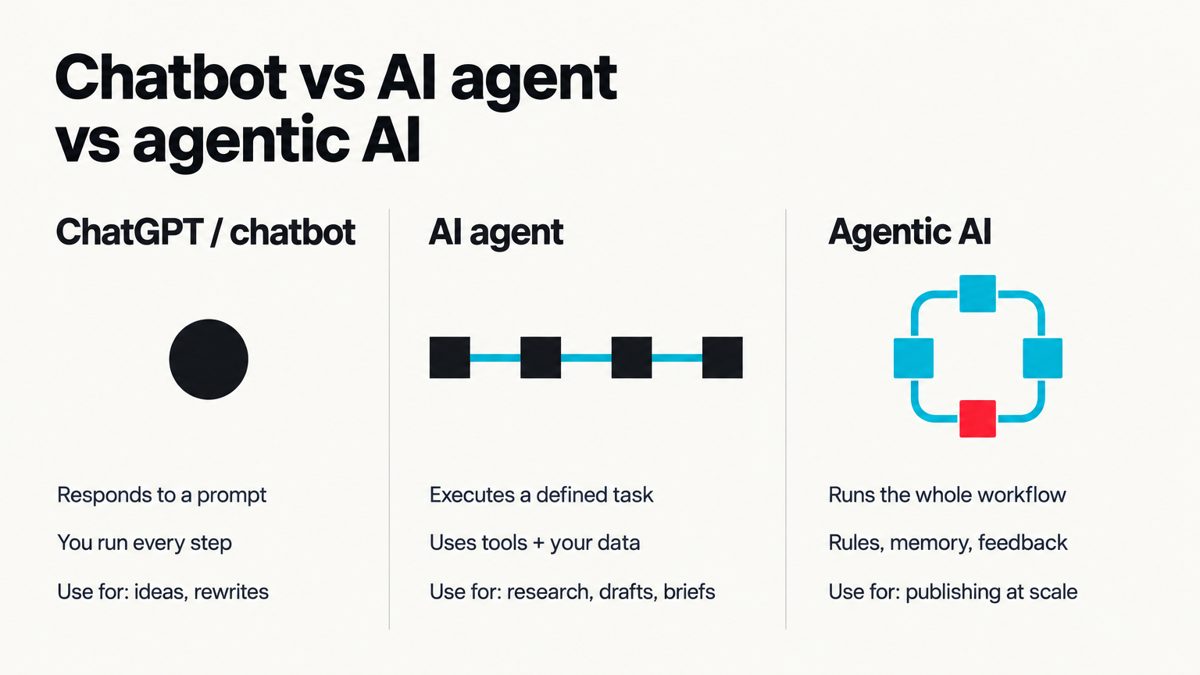
There are three different things people call "AI" now: chatbots, AI agents and agentic AI. Each one fits different work. Pick the wrong one and you get generic output, no matter how good your prompt is. This guide covers what each one is, when to use it, and how to move your content from prompting to an agent that executes.
The short answer
- Use a chatbot (ChatGPT, Claude, Gemini) for one-off thinking: brainstorming angles, rewriting a paragraph, pressure-testing an argument.
- Use an AI agent for a defined task that needs tools and your data: researching a topic, pulling numbers from your CRM, drafting against a brief.
- Use agentic AI when the whole workflow has to run on repeat: research, write, illustrate, check, publish and log, every week, to the same standard.
Why ChatGPT content looks like slop
AI writing is mainstream now. HubSpot reports that 46% of marketers use AI to write blog posts and articles. Yet only 7% publish AI drafts unedited. 56% heavily revise or rewrite them. So most teams already know the chatbot draft isn't good enough. They just keep paying for it in editing hours.
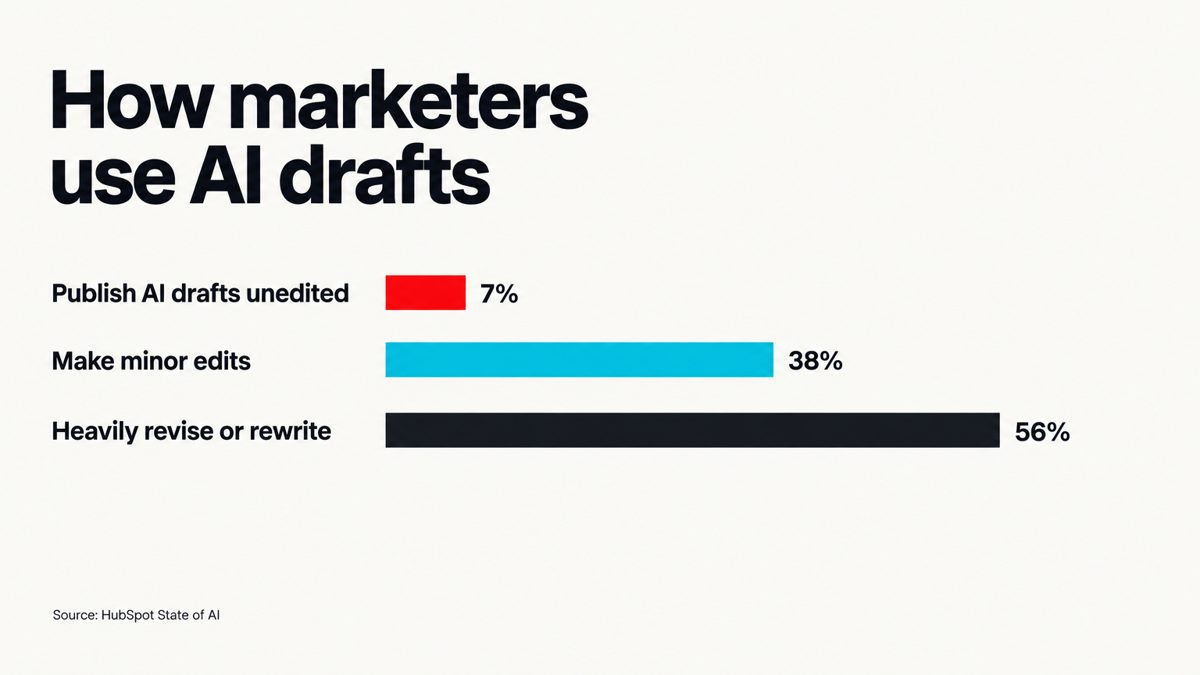
Source: HubSpot State of AI. 7% unedited, 38% minor edits, 56% heavy revision.
Google won't punish you for that slop either: it doesn't penalize content just because AI helped write it. Ahrefs found AI-generated material on 86.5% of top-ranking pages. Readers are the problem. Edelman found that more than two-thirds of US and UK generative-AI distrusters say the technology "feels forced." Slop doesn't get you penalized. It gets you ignored.
Chatbot slop comes from three gaps:
- No context. A chatbot has never seen your ICP, your positioning or your customer data. It fills the gaps with the average of the internet.
- No evidence. It can't query your CRM or check a live source unless you do it for it. So you get claims without proof.
- No memory of your rules. Every session starts from zero. Your brand voice, your banned phrases and last week's feedback disappear.
Chatbot vs AI agent vs agentic AI
| Chatbot | AI agent | Agentic AI | |
|---|---|---|---|
| What it does | Responds to a prompt | Executes a defined task | Runs a full workflow end to end |
| Who drives | You, every step | The goal you set | The system, inside your rules |
| Data access | What you paste in | Tools, APIs, your knowledge base | Tools plus memory and feedback loops |
| Best for | Ideas, rewrites, Q&A | Research, drafts, briefs, enrichment | Publishing and pipeline at scale |
| Slop risk | High | Medium | Low, if the rules are written down |
A warning: vendors blur these labels. Gartner calls it "agent washing" and estimates that only about 130 of the thousands of vendors claiming agentic capabilities actually offer them. Gartner also predicts that more than 40% of agentic AI projects will be canceled by the end of 2027, mostly because of unclear value and weak controls. Agentic AI pays off when it runs a workflow you can measure. It doesn't pay off as a label on a chatbot.
When to use each (a decision test)
Ask three questions about the job:
- Does it happen once, or every week? Once: a chatbot is fine. Every week: you need an agent.
- Does it need your data or live sources? If yes, a chatbot will make it up. Use an agent with tool access.
- Does it have more than three steps that must hit the same standard every time? If yes, use agentic AI: rules, memory and an output it can measure.
A blog program answers yes to all three. That's why "ChatGPT for blogs" stops working once you publish more than a few posts.
Our own data: what an agent-run blog looks like
We run this blog on our own 10ex Blog Agent. Over 18 days (Oct 25 to Nov 12) it drafted 22 posts, and 17 were published. It finished 19 of 19 runs, averaging 14.1 minutes each, not counting the final publish approval. That covers research, our CRM data, writing, images and the topic log.
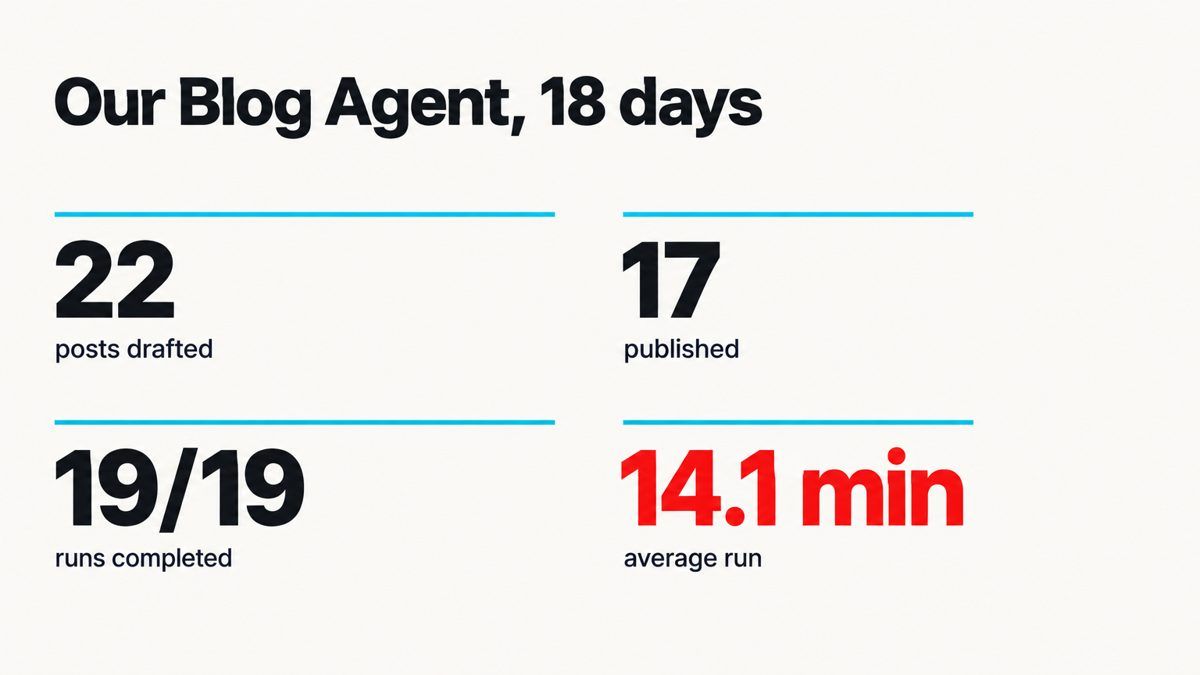
10ex Blog Agent, Oct 25 to Nov 12: 22 drafted, 17 published, 19/19 runs completed, 14.1 minutes per run.
Slop doesn't get through because of the rules the agent runs against, not because someone edits after it:
- A knowledge base with ICP, positioning and voice, so the post sounds like us.
- Live research through search, scrapers and keyword data, so claims have sources.
- First-party data from the CRM, so every post carries numbers no competitor has.
- A locked visual style, so every image is on-brand.
- A topic log, so it never writes the same post twice.
How to move from prompting to an agent
- Write your rules down once. Voice, banned phrases, structure, CTA, image style. If it only lives in your head, the AI can't follow it.
- Connect your data. Knowledge base, CRM, Search Console. This is what turns generic into original.
- Give it tools. Search, scraping, keyword planning, image generation, CMS publishing.
- Define "done." Word count, required data points, charts with numbers, meta description under 155 characters.
- Feed corrections back as rules, not as one-off edits. Every fix should make the next post better.
- Keep ChatGPT for thinking. It's still the fastest sparring partner you have. Just don't let it run the job.
FAQ
Is ChatGPT an AI agent?
Not by default. ChatGPT is a chatbot: it responds to prompts. It can use some tools, but you still drive every step. An agent pursues a goal across several steps using tools and your data.
What's the difference between AI agents and agentic AI?
An AI agent is one system doing one defined job. Agentic AI is the wider setup: agents plus rules, memory, tools and feedback loops that run whole workflows on their own.
Does Google penalize AI-written content?
No. Google judges helpfulness, not authorship. AI content that adds nothing original will lose anyway, to readers first and to rankings next.
How do I stop AI content from sounding generic?
Give the AI your context and data, not just a prompt. Original numbers, a clear point of view and written brand rules do more than any prompt trick.
Stop prompting. Start executing.
A chatbot gives you a draft. An agent gives you a finished, published post with your data, your voice and your visuals, while you sleep. 10ex runs autonomous agents across blog, GEO, LinkedIn, Reddit and outbound, so your whole GTM runs this way, not just your content. See 10ex agents run your pipeline →