Digital Marketing
Agentic GTM 101: How Autonomous AI Agents Take B2B SaaS Pipeline From Prospect to Booked Meeting
Nikhil Adiga · · 9 min read
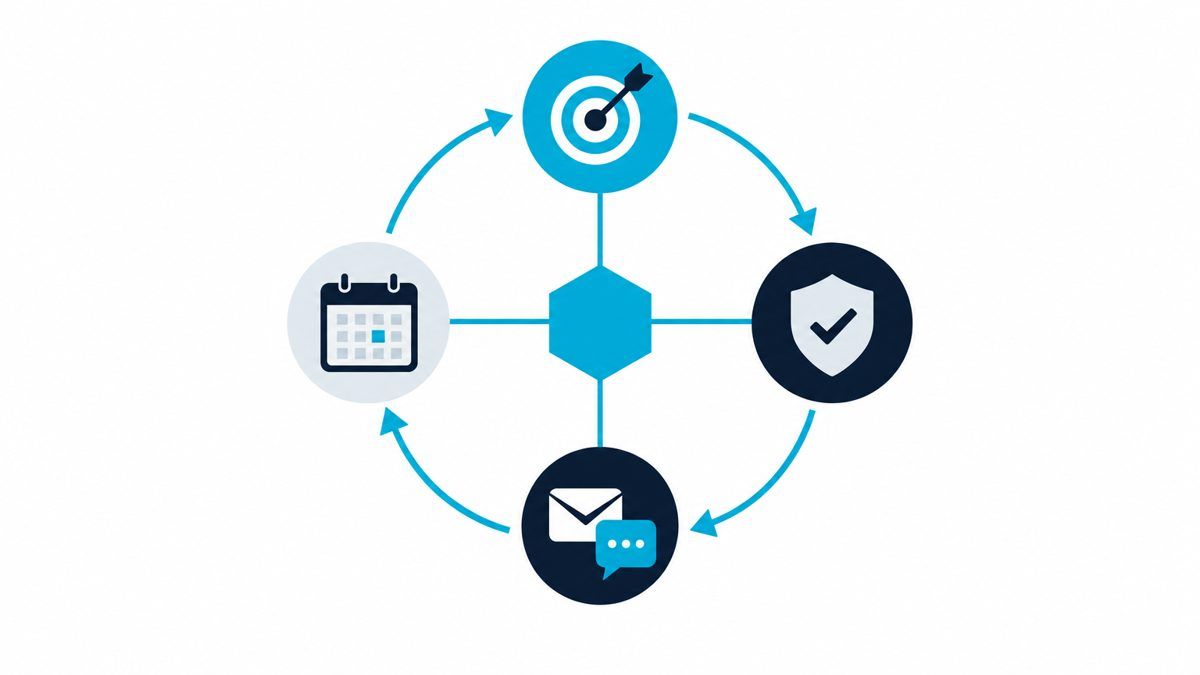
Agentic GTM is a go-to-market motion where autonomous AI agents own the pipeline outcome. They find your buyers, check the contact data, run outreach across channels and put qualified meetings on your calendar. Nobody has to push each step along by hand.
For a seed to Series B team, this changes the hiring plan. You stop recruiting, ramping and replacing SDRs. Instead you define the ICP, the offer and the guardrails, and agents run the motion at a volume a five-person team cannot reach. This guide covers what agentic go-to-market is, how agents handle the four core jobs, and the six steps to launch it in your company.
Agentic GTM means agents own the outcome, not the task
Most "AI for sales" tools are assistants. They draft an email, suggest a lead or summarize a call, and then a human has to review, click send, chase the reply and book the slot. The work still runs at the speed of the person in the loop.
An agentic system works the other way around. You give it a goal, such as qualified meetings with VPs of Engineering at Series A fintechs. The agents then plan and carry out every step needed to get there, and they learn from each reply. The difference is who carries the work from one step to the next.
GTM job | Assistive AI (helps a rep) | Agentic GTM (does the job)
Prospecting | Suggests leads for a rep to review | Builds and refreshes the target list from ICP filters and live signals
Enrichment | Fills fields from one database | Checks contacts against several sources and drops the ones that don't verify
Outreach | Drafts a message for approval | Writes, sends and sequences across email, LinkedIn, Reddit and content
Follow-up | Reminds the rep to follow up | Reads every reply, answers questions and handles routine objections
Meeting booking | Sends a scheduling link when asked | Proposes times, books the slot and hands over context
Success metric | Hours saved per rep | Meetings held and cost per meeting
That last row is what matters. An assistive tool makes each rep somewhat faster. An agentic GTM platform is judged on whether meetings land on the calendar.
The SDR math breaks before your Series B does
Hiring SDRs isn't a bad idea. The problem is that at an early stage the costs pile up faster than the pipeline does.
The average SDR takes 3.0 months to ramp and stays 1.9 years. That leaves about 20 months of full productivity from each hire before you start recruiting again. Median annual SDR attrition is 40%, so a team of five loses about two seats every year.
Median SDR on-target earnings are $80,000. That figure doesn't include payroll taxes, benefits, tools, recruiting, or the manager you need once the team passes three or four reps. Even a fully staffed team spends only about 40% of its time actually selling. The rest goes to research, data cleanup, CRM updates and admin.
Then there is the channel. Across 7.5 million cold emails, the average reply rate was 0.45%. At that rate, volume and accuracy decide whether outbound works at all. A small human team can't produce enough of either.
Hiring headcount to scale outbound means paying for three months of ramp so you can get twenty months of output. Agents skip the hiring cycle and don't quit in month 23.
Autonomous AI agents run four GTM jobs as one continuous loop
In agentic go-to-market, prospecting, enrichment, outreach and booking aren't four separate tools tied together with exports. They are one loop. Every reply, bounce and booked meeting feeds the next search.
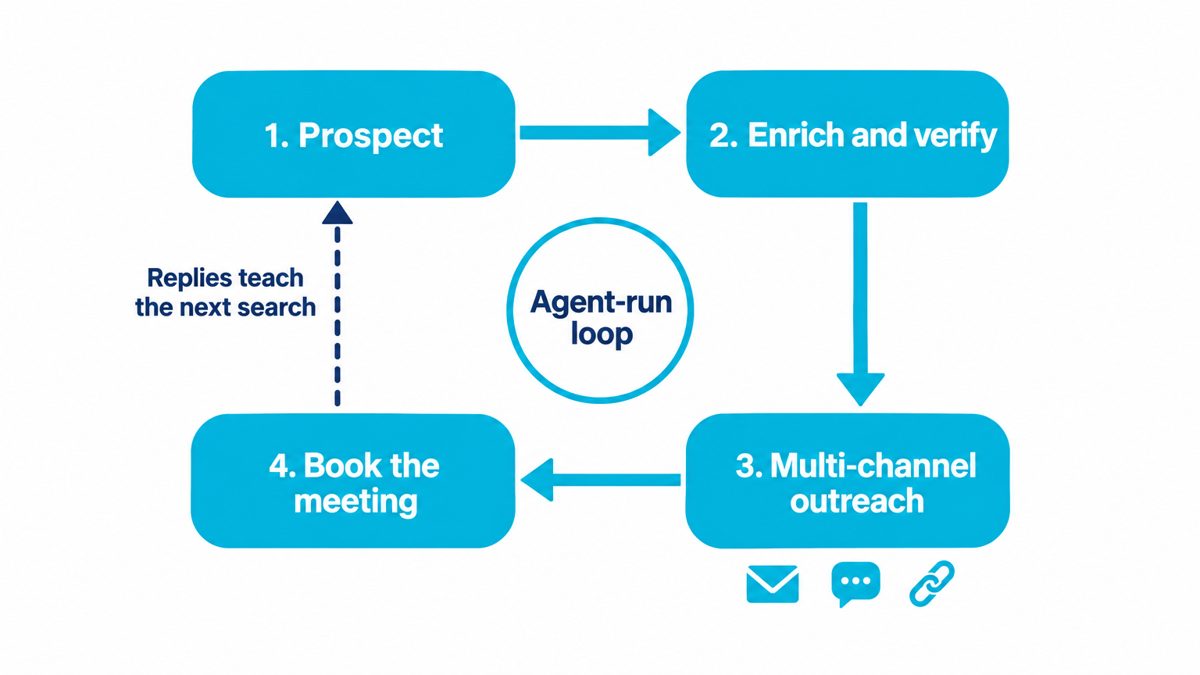
Prospecting starts from your product, not a purchased list
Autonomous prospecting starts with the agent reading your product: your site, docs, pricing page and the profile of your best customers. From that it works out who has the problem you solve. It then searches for accounts that match both firmographic filters and live buying signals.
Take a Series A company that sells CI tooling to platform teams. Its agent would look for companies hiring platform engineers, engineering leaders posting about build times on LinkedIn, and Reddit threads where developers complain about flaky pipelines. A static list can't see any of those signals. An agent sees them the day they appear.
Enrichment cross-checks every contact before a single send
Bad data is the quietest way to kill outbound. The average cold email bounce rate is 3.6% across 31 million sends. Every bounce damages the sender reputation that decides whether your next email reaches the inbox.
Agentic enrichment checks each contact against several data sources instead of trusting one. If the sources disagree on an email, a title or whether the person still works there, the agent drops the contact or looks for a better one. It doesn't send and hope. You pay for fewer contacts, and far more of them are real.
Multi-channel outreach meets buyers where they actually research
Buyers don't only check their inbox anymore. 94% of B2B buyers use LLMs during the purchase process. That means part of your pipeline depends on whether AI answers recommend you, which is generative engine optimization (GEO).
So AI sales agents work several channels together. Sequenced email goes to verified contacts. LinkedIn touches go to the same people. Helpful replies go into the Reddit threads where your buyers discuss the problem. Blog and GEO content gets your product cited when buyers ask an LLM for options. An on-site chatbot catches the visitors all of this brings in. Each channel supports the others, so a buyer who ignores email may still meet you in a thread or an AI answer.
Meeting booking happens at machine speed, with context handed off
Speed decides who gets the meeting. A lead contacted within 5 minutes instead of 30 is 21 times more likely to qualify. A human SDR who is in a call, at lunch or asleep in another time zone can't keep that pace. An agent can.
The booking agent reads the reply and answers product questions from your own material. It handles routine objections like "send me more info" or "not this quarter", offers times and books the slot. The account executive then gets the full thread, the signals behind the first touch and the prospect's stated pain. The first call starts at minute ten, not minute zero.
Five inputs decide whether your agents print pipeline or burn domains
Agents scale whatever you give them, including your mistakes. Get these five inputs ready before you switch anything on:
- An ICP written as filters, not adjectives. "B2B SaaS, 20 to 150 employees, raised in the last 12 months, hiring sales" can be run by an agent. "Fast-growing tech companies" can't.
- One offer per segment. Each segment needs a specific problem, a specific outcome and a low-friction ask. Agents can personalize a message, but they can't fix a vague one.
- Proof the agents can quote. Product docs, objection answers, pricing logic and anonymized customer outcomes. This is the material agents use to answer replies accurately.
- Sending infrastructure. Secondary domains that are authenticated and warmed, so outbound volume never puts your primary domain at risk.
- Guardrails and access. Exclusion lists (current customers, open opportunities, partners), calendar and CRM connections, and a clear rule for when a conversation goes to a human.
How to launch agentic go-to-market in six steps
The fastest launches start narrow, prove meetings, and only then add volume. Here is the sequence.
Step 1: Feed the agents your product and your best wins
Connect your site, docs and CRM. Mark the 10 to 20 deals you would happily repeat. The agents learn your buyer from the customers who actually paid, not from the persona slide.
Step 2: Turn the ICP into filters and signals
Write firmographic filters (industry, headcount, funding stage, geography) and pair them with two or three buying signals, such as a relevant job post, a tech stack change or a public complaint about the problem you solve. Signals decide who gets contacted this week.
Step 3: Set guardrails before you set volume
Load the exclusion lists, set daily sending caps per domain, and define the handoff rules. For example, pricing negotiations, legal questions and anyone above a certain title go straight to a founder.
Step 4: Launch one segment on two channels
Start with your sharpest segment and two channels, usually verified email plus LinkedIn. Add Reddit, content and GEO once the core message is producing replies. Running one segment shows you which message works. Running five at once shows you nothing.
Step 5: Let agents book, and spend your time in the meetings
Resist the urge to approve every reply. Have someone review a sample of conversations each day for tone and accuracy, and let the agents book. The founder's or AE's job is now to run great first calls.
Step 6: Review weekly on meetings, then expand
Track four numbers: meetings held, cost per meeting compared with your fully loaded SDR cost, bounce rate compared with the 3.6% average, and reply rate compared with the 0.45% cold email baseline. When a segment beats all four, copy the setup to the next segment.
Agentic GTM still needs a human in three places
Agents replace the repetitive work of an SDR team, not your judgment. Three jobs stay human, and pretending otherwise is how teams get burned.
- Positioning. Agents carry out your ICP and message at scale. If the ICP is wrong, they find the wrong buyers very efficiently, and you find out sooner, which is useful, but only if you're watching.
- Closing. A booked meeting isn't revenue. Discovery, demos and negotiation still need someone who can read the room.
- Edge cases. A strategic logo, an angry reply, a press inquiry. Your handoff rules should send these to a human fast, and the daily review should catch anything the rules miss.
Expect a short calibration period. The first week of replies will show gaps in your proof material and objection answers. Fill those gaps and the agents improve with them.
Agentic GTM FAQ
What is agentic GTM?
Agentic GTM (agentic go-to-market) is a pipeline motion where autonomous AI agents carry out prospecting, data enrichment, multi-channel outreach and meeting booking end to end, measured on meetings held rather than tasks completed.
How is agentic GTM different from sales automation tools?
Sales automation runs fixed sequences that a rep sets up and babysits. Agentic GTM plans its own next step: it picks accounts from live signals, verifies contacts, adapts messages to replies and books the meeting without waiting on a person.
Does agentic GTM replace SDRs?
For most seed to Series B teams, yes. Agents take over list building, research, outreach, follow-up and booking. Founders and AEs keep positioning and closing.
How fast can a team see results?
Start one segment on two channels and judge it on meetings held after a few weeks of sending. Expand only once the first segment beats your SDR cost per meeting.
Put your pipeline on autopilot
10ex deploys autonomous agents that find your buyers, verify every contact, run outreach across email, LinkedIn, Reddit, blog and GEO, and book meetings on your calendar. Book a demo at 10ex.ai and watch the agents fill your calendar.